
Research Library
Source-backed research for better staffing decisions
Use these reports to compare roles, costs, controls, and onboarding decisions before building a Philippines-based support team.

 legal-support-governance
Can a conflict waiver decision be reproduced from the matter file?
Waiver files often missing the client's own words
An evidence test for conflict waiver files: whether a reviewer can reconstruct the conflict, the client's answer, the authority, and any limit without asking the people involved.
 legal-support-governance
Do client production releases leave a receipt the firm can verify?
Delivery receipts are weaker than send records
A test of release records from scope note to delivery receipt, showing which parts of a client production can be verified after the fact and which cannot.
 legal-support-governance
How often do hearing binder indexes miss the exhibit version used at the hearing?
Exhibit version gaps are a measurable index defect
A bounded method for comparing the exhibit version named in a hearing binder index with the version used at the hearing, and a clear limit on what the result can prove.
 legal-support-governance
How predictable is a legal vendor renewal date from the contract record?
Renewal dates depend on executed copies, not invoices
A contract-record test for renewal predictability: whether a reviewer can calculate the notice and renewal dates without calling the vendor, and where the record fails.
 legal-support-governance
Where does confidentiality risk accumulate in a shared legal inbox?
Mailbox risk concentrates at access and handoff
A method for locating confidentiality risk in a shared legal inbox by message, access path, and handoff, with a clear limit on what the count can prove.
 legal-support-records
Can a closed-matter retention decision be reproduced from the file?
A retention decision is only as good as the record behind it
A documentary test of whether a closed-matter retention or disposal decision can be rebuilt from the category, the trigger date, the hold check, and the approval.
 legal-support-operations
How early do scope changes appear in legal matter budgets?
Early scope signals matter more than a late variance report
A bounded method for measuring the lag between a documented scope change and its appearance in the matter budget, with a clear limit on what the timing can prove.
 legal-support-governance
How late do legal hold acknowledgments arrive after the reminder?
Late acknowledgments are a process signal, not a legal conclusion
A bounded method for measuring the gap between the first reminder and a custodian's acknowledgment, with a clear limit on what the result can prove.
 legal-support-quality
Measuring docket change review coverage across active matters
Coverage measures the check, not the legal outcome
A bounded method for checking whether every active matter received a dated docket review, without treating coverage as proof that no deadline was missed.
 legal-support-evidence
Where do expert witness engagement files lose source evidence?
The handoff, not the expert, is often where the record breaks
A bounded study of the point at which expert engagement records stop linking a credential, a material, or a draft back to its source.
 legal-support-contracts
Can a contract abstraction be reproduced from its source clauses?
Traceability is the test of a useful abstraction
A documentary test of whether contract abstractions preserve the clause, defined term, and version needed for independent review.
 legal-support-governance
How often do legal matter records lack a named reviewer?
A named reviewer is a control, not a formality
A bounded method for measuring whether legal matter records name the person accountable for the next decision.
 legal-support-quality
Measuring redaction quality before a production release
Redaction quality needs a repeatable check
A bounded method for checking redaction coverage, consistency, and reviewer sign-off before documents leave the firm.
 legal-support-governance
Testing whether legal handoffs preserve the source reference
A handoff is only as good as the reference it preserves
A method for checking whether a completed legal handoff keeps the source, the action, and the reviewer connected.
 legal-support-operations
Where does delay accumulate in a legal intake queue?
Delay belongs to a stage before it belongs to a person
A stage-level method for locating wait time in legal intake without treating every long cycle as a performance problem.
 Evidence Quality
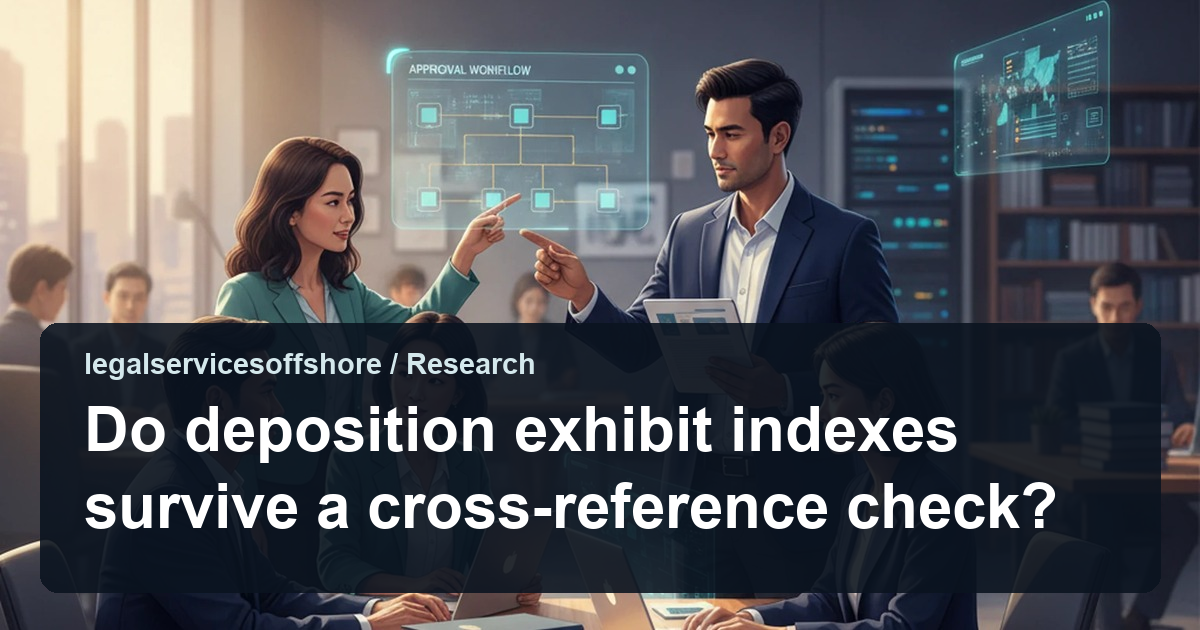
Do deposition exhibit indexes survive a cross-reference check?
An exhibit index is only as reliable as the transcript and file references behind each row.
A bounded method for testing whether an exhibit index matches the transcript, the source file, and the admission status recorded in the case.
 Review Consistency
Measuring contract abstraction accuracy against the source clause
Accuracy should be measured at the row and clause level, not by how complete the worksheet looks.
A repeatable review that tests whether each abstraction row matches the operative clause, the defined term, and the version of the agreement that was reviewed.
 Evidence Quality
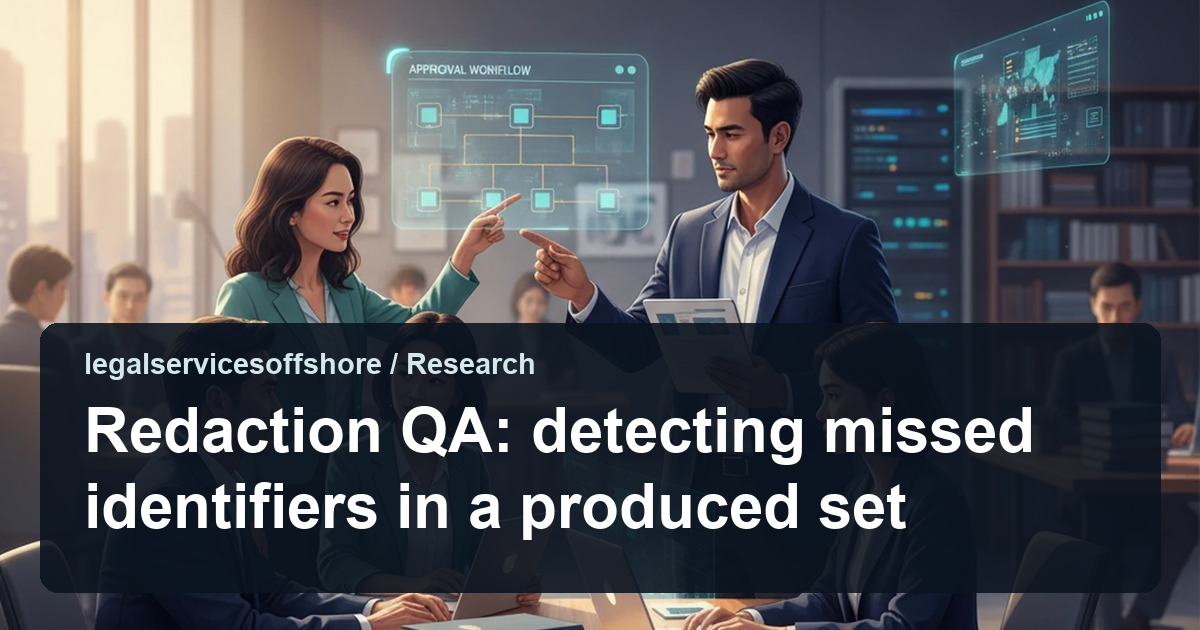
Redaction QA: detecting missed identifiers in a produced set
A redaction is only complete when the text, the metadata, and the file path agree.
A sampling and search protocol for testing whether a redacted production still exposes names, account numbers, or metadata that should have been removed.
 Access Governance
Trust request evidence: what a disbursement file shows
A trust request is only reviewable when the approval, the evidence, and the ledger entry line up.
A bounded review of whether trust disbursement requests carry the ledger match, the authorization, the supporting document, and the posting confirmation.
 Handoff Reliability
Where client document dumps stall before review
Delay is easier to fix when it is measured by stage rather than blamed on the whole intake.
A stage-by-stage method for locating the delay between a client production and the first substantive review, using a frozen collection and a written intake standard.
 Access Governance
Access recertification patterns for offshore legal support
Access recertification is useful when it can show why an account still needs each permission.
A bounded study of whether offshore legal support accounts still match the matters, tools, and review role they were granted for.
 Workflow Design
Deadline calendar reconciliation: sources and gaps
A calendar entry is only as reliable as the source and approval linked to it.
A study design for comparing court notices, approved deadline notes, and calendar entries to find where a legal deadline record stops agreeing with its source.
 Evidence Quality
Measuring intake completeness in a distributed legal team
Intake completeness should be measured against a defined evidence standard, not against how polished the packet looks.
A bounded protocol for measuring whether matter intake records carry the request, source evidence, conflict status, and decision needed for attorney review.
 Review Consistency
Reviewer agreement in privilege log preparation
Agreement is a property of the review standard as much as of the reviewers.
A method for studying whether two trained reviewers classify privilege log entries the same way, and where the definitions rather than the documents cause disagreement.
 Workflow Design
Where matter handoffs lose evidence
A handoff is reliable when a second reviewer can reconstruct the next action from the record alone.
A study design for locating the point in a legal matter handoff where the source, owner, status, or next action stops being reproducible.
 dictionary
Build a data dictionary for privilege log evidence
A grounded legal support operations note for law firm administrators: privilege log with explicit evidence, decision rights, and a verified close.
A grounded legal support operations note for law firm administrators: privilege log with explicit evidence, decision rights, and a verified close.
 measures
Choose document index measures that can be defended
A grounded legal support operations note for law firm administrators: document index with explicit evidence, decision rights, and a verified close.
A grounded legal support operations note for law firm administrators: document index with explicit evidence, decision rights, and a verified close.
 population
Decide who belongs in the conflict packet frame
A grounded legal support operations note for law firm administrators: conflict packet with explicit evidence, decision rights, and a verified close.
A grounded legal support operations note for law firm administrators: conflict packet with explicit evidence, decision rights, and a verified close.
 sampling
Draw a deadline calendar sample that can be repeated
A grounded legal support operations note for law firm administrators: deadline calendar with explicit evidence, decision rights, and a verified close.
A grounded legal support operations note for law firm administrators: deadline calendar with explicit evidence, decision rights, and a verified close.
 framing
Frame the matter intake question before collecting data
A grounded legal support operations note for law firm administrators: matter intake with explicit evidence, decision rights, and a verified close.
A grounded legal support operations note for law firm administrators: matter intake with explicit evidence, decision rights, and a verified close.
 Measurement
Can the privilege log report be reproduced from its sources?
A repeatable measurement protocol for privilege log in offshore legal support, with definitions, sampling, limits, and reporting.
A repeatable measurement protocol for privilege log in offshore legal support, with definitions, sampling, limits, and reporting.
 Evidence Quality
How complete is the evidence in the matter intake record?
A repeatable measurement protocol for matter intake in offshore legal support, with definitions, sampling, limits, and reporting.
A repeatable measurement protocol for matter intake in offshore legal support, with definitions, sampling, limits, and reporting.
 Queue Health
How old are the exceptions in the deadline calendar queue?
A repeatable measurement protocol for deadline calendar in offshore legal support, with definitions, sampling, limits, and reporting.
A repeatable measurement protocol for deadline calendar in offshore legal support, with definitions, sampling, limits, and reporting.
 Capacity
What happens to document version control coverage when the owner is away?
A repeatable measurement protocol for document version control in offshore legal support, with definitions, sampling, limits, and reporting.
A repeatable measurement protocol for document version control in offshore legal support, with definitions, sampling, limits, and reporting.
 Timing
Where does delay accumulate in the conflict check handoff?
A repeatable measurement protocol for conflict check in offshore legal support, with definitions, sampling, limits, and reporting.
A repeatable measurement protocol for conflict check in offshore legal support, with definitions, sampling, limits, and reporting.
 coverage
Auditing backup-owner coverage for privilege log
A grounded legal support operations note for law firm administrators: privilege log with explicit evidence, decision rights, and a verified close.
A grounded legal support operations note for law firm administrators: privilege log with explicit evidence, decision rights, and a verified close.
 cost
Estimating exception spillover in document index
A grounded legal support operations note for law firm administrators: document index with explicit evidence, decision rights, and a verified close.
A grounded legal support operations note for law firm administrators: document index with explicit evidence, decision rights, and a verified close.
 measurement
Measuring decision latency in matter intake
A grounded legal support operations note for law firm administrators: matter intake with explicit evidence, decision rights, and a verified close.
A grounded legal support operations note for law firm administrators: matter intake with explicit evidence, decision rights, and a verified close.
 quality
Testing evidence retention across conflict packet corrections
A grounded legal support operations note for law firm administrators: conflict packet with explicit evidence, decision rights, and a verified close.
A grounded legal support operations note for law firm administrators: conflict packet with explicit evidence, decision rights, and a verified close.
 monitoring
Testing whether deadline calendar audit samples detect silent gaps
A grounded legal support operations note for law firm administrators: deadline calendar with explicit evidence, decision rights, and a verified close.
A grounded legal support operations note for law firm administrators: deadline calendar with explicit evidence, decision rights, and a verified close.
 access
Auditing access changes around privilege log
A grounded legal support operations note for law firm administrators: privilege log with explicit evidence, decision rights, and a verified close.
A grounded legal support operations note for law firm administrators: privilege log with explicit evidence, decision rights, and a verified close.
 cost
Estimating rework in document index from correction and reopen records
A grounded legal support operations note for law firm administrators: document index with explicit evidence, decision rights, and a verified close.
A grounded legal support operations note for law firm administrators: document index with explicit evidence, decision rights, and a verified close.
 measurement
Measuring cycle time for matter intake from request to verified close
A grounded legal support operations note for law firm administrators: matter intake with explicit evidence, decision rights, and a verified close.
A grounded legal support operations note for law firm administrators: matter intake with explicit evidence, decision rights, and a verified close.
 quality
Testing evidence completeness in conflict packet without a convenience sample
A grounded legal support operations note for law firm administrators: conflict packet with explicit evidence, decision rights, and a verified close.
A grounded legal support operations note for law firm administrators: conflict packet with explicit evidence, decision rights, and a verified close.
 monitoring
Testing whether deadline calendar monitoring catches silent failures
A grounded legal support operations note for law firm administrators: deadline calendar with explicit evidence, decision rights, and a verified close.
A grounded legal support operations note for law firm administrators: deadline calendar with explicit evidence, decision rights, and a verified close.
 access
Auditing access changes around outside counsel invoice
A source-bounded legal support operations control note for law firm administrators: outside counsel invoice with clear ownership and evidence.
A source-bounded legal support operations control note for law firm administrators: outside counsel invoice with clear ownership and evidence.
 cost
Estimating rework cost in deadline calendar
A source-bounded legal support operations control note for law firm administrators: deadline calendar with clear ownership and evidence.
A source-bounded legal support operations control note for law firm administrators: deadline calendar with clear ownership and evidence.
 measurement
Measuring backlog age in document index
A source-bounded legal support operations control note for law firm administrators: document index with clear ownership and evidence.
A source-bounded legal support operations control note for law firm administrators: document index with clear ownership and evidence.
 quality
Testing handoff completeness in privilege log
A source-bounded legal support operations control note for law firm administrators: privilege log with clear ownership and evidence.
A source-bounded legal support operations control note for law firm administrators: privilege log with clear ownership and evidence.
 monitoring
Testing monitoring coverage for client update
A source-bounded legal support operations control note for law firm administrators: client update with clear ownership and evidence.
A source-bounded legal support operations control note for law firm administrators: client update with clear ownership and evidence.
 quality analysis
Attributing rework in the deadline calendar
A source-bounded legal support operations guide for law firm administrators: deadline calendar without unsupported decisions.
A source-bounded legal support operations guide for law firm administrators: deadline calendar without unsupported decisions.
 capacity and coverage
Capacity planning for outside-counsel invoices
A source-bounded legal support operations guide for law firm administrators: outside counsel invoice without unsupported decisions.
A source-bounded legal support operations guide for law firm administrators: outside counsel invoice without unsupported decisions.
 risk review
Early-warning signals in client updates
A source-bounded legal support operations guide for law firm administrators: client update without unsupported decisions.
A source-bounded legal support operations guide for law firm administrators: client update without unsupported decisions.
 measurement
Measuring response time for the document index
A source-bounded legal support operations guide for law firm administrators: document index without unsupported decisions.
A source-bounded legal support operations guide for law firm administrators: document index without unsupported decisions.
 measurement
Testing completeness in privilege logs
A source-bounded legal support operations guide for law firm administrators: privilege log without unsupported decisions.
A source-bounded legal support operations guide for law firm administrators: privilege log without unsupported decisions.
 Intake Controls
Conflict screening quality: a sampling method for intake packets
Four packet fields, one declared review window, and zero substituted legal conclusions.
A bounded method for testing whether conflict-check intake packets contain the parties, sources, and search evidence a lawyer needs before clearing a matter.
 Litigation Support
Docket verification reliability: measuring alert-to-record agreement
One official record per alert, three discrepancy classes, and no deadline inferred from a summary.
A method for testing whether docket alerts match the official court record, with fields, discrepancy classes, and reporting limits.
 Preservation Operations
Measuring legal hold acknowledgment without overclaiming compliance
Delivery and acknowledgment counted separately, with departures and reminders visible.
A metric set for hold delivery, acknowledgment, reminders, and departures that reports the gaps instead of averaging them away.
 Production Controls
Sampling Bates productions for sequence and legibility errors
Three error classes, a full sequence check, and a sampled legibility review.
A practical sample design for finding numbering gaps, duplicate stamps, and unreadable pages before a production is served.
 Discovery Controls
Sampling privilege logs for completeness, not privilege
Withheld set to log, one field standard, and no privilege conclusion by the support team.
A reproducible check that every withheld document appears on the log and each entry carries counsel-approved fields, without substituting a privilege decision.
 Workflow Design
Citation Location Replay in Legal Support Work Products
10 authoritative context sources, one declared observation unit, and zero guaranteed legal or business outcomes.
A source-led legal-operations protocol for citation location replay, with a declared population, adverse cases, denominator discipline, independent replay, privacy controls, and explicit limits.
 Hiring Controls
Matter Code Reclassification Reliability in Legal Support Operations
10 authoritative context sources, one declared observation unit, and zero guaranteed legal or business outcomes.
A source-led legal-operations protocol for matter code reclassification reliability, with a declared population, adverse cases, denominator discipline, independent replay, privacy controls, and explicit limits.
 Workflow Design
Review Queue Interruption in Offshore Legal Support: A Study Protocol
10 authoritative context sources, one declared observation unit, and zero guaranteed legal or business outcomes.
A source-led legal-operations protocol for review queue interruption, with a declared population, adverse cases, denominator discipline, independent replay, privacy controls, and explicit limits.
 Hiring Controls
Reviewer Acknowledgment Lag in Offshore Legal Workflows
10 authoritative context sources, one declared observation unit, and zero guaranteed legal or business outcomes.
A source-led legal-operations protocol for reviewer acknowledgment lag, with a declared population, adverse cases, denominator discipline, independent replay, privacy controls, and explicit limits.
 Scope Benchmarks
Shared Link Revocation in Offshore Legal Teams: A Control Study
10 authoritative context sources, one declared observation unit, and zero guaranteed legal or business outcomes.
A source-led legal-operations protocol for shared link revocation completeness, with a declared population, adverse cases, denominator discipline, independent replay, privacy controls, and explicit limits.
 Hiring Controls
Completion and Acceptance Divergence in Offshore Legal Workflows
10 authoritative context sources, one declared observation unit, and zero guaranteed legal or business outcomes.
A source-led legal-operations protocol for completion and acceptance divergence, with a declared population, adverse cases, denominator discipline, independent replay, privacy controls, and explicit limits.
 Hiring Controls
Exception Taxonomy Reliability in Legal Support Operations
10 authoritative context sources, one declared observation unit, and zero guaranteed legal or business outcomes.
A source-led legal-operations protocol for exception taxonomy reliability, with a declared population, adverse cases, denominator discipline, independent replay, privacy controls, and explicit limits.
 Scope Benchmarks
Matter Access Creep in Offshore Legal Teams: A Longitudinal Control Study
10 authoritative context sources, one declared observation unit, and zero guaranteed legal or business outcomes.
A source-led legal-operations protocol for matter access creep, with a declared population, adverse cases, denominator discipline, independent replay, privacy controls, and explicit limits.
 Workflow Design
Reviewer Capacity Saturation in Offshore Legal Support: A Study Protocol
10 authoritative context sources, one declared observation unit, and zero guaranteed legal or business outcomes.
A source-led legal-operations protocol for reviewer capacity saturation, with a declared population, adverse cases, denominator discipline, independent replay, privacy controls, and explicit limits.
 Workflow Design
Source-to-Summary Traceability in Legal Support Work Products
10 authoritative context sources, one declared observation unit, and zero guaranteed legal or business outcomes.
A source-led legal-operations protocol for source-to-summary traceability, with a declared population, adverse cases, denominator discipline, independent replay, privacy controls, and explicit limits.
 Hiring Controls
Access Revocation Proof After a Legal Support Role Change
10 authoritative sources and one bounded administrative observation unit.
A source-led observational study of access revocation proof using a defined population, authority boundary, chronology, independent review, and explicit limitations.
Hiring ControlsConfidential Transfer Reliability in Legal Operations Support
10 authoritative sources and one bounded administrative observation unit.
A source-led observational study of confidential transfer reliability using a defined population, authority boundary, chronology, independent review, and explicit limitations.
Workflow DesignException Aging in a Supervised Offshore Legal Queue
10 authoritative sources and one bounded administrative observation unit.
A source-led observational study of exception aging using a defined population, authority boundary, chronology, independent review, and explicit limitations.
Workflow DesignLawyer Review Capacity for Offshore Legal Support
10 authoritative sources and one bounded administrative observation unit.
A source-led observational study of lawyer review capacity using a defined population, authority boundary, chronology, independent review, and explicit limitations.
Scope BenchmarksReconstructing Source Provenance in Offshore Legal Support
10 authoritative sources and one bounded administrative observation unit.
A source-led observational study of source provenance reconstruction using a defined population, authority boundary, chronology, independent review, and explicit limitations.
Scope BenchmarksBankruptcy claim packet indexing with offshore legal support
Method focus: test packet reconstruction without delegating creditor, amount, priority, filing, or legal-sufficiency judgments.
A controlled study of official-form identity, attachment lineage, amendment history, and attorney-owned claim decisions.
Workflow DesignDeposition exhibit provenance in offshore legal support
Decision focus: can an exhibit inventory remain reconstructable through renaming, pagination, and duplicate handling?
A source-lineage study for preparing deposition exhibit inventories while counsel retains selection, use, privilege, and examination decisions.
Hiring ControlsService-of-process proof records in offshore legal support
Governance focus: keep service events attributable without allowing an administrative log to declare service valid.
A source-comparison study for organizing service evidence while lawyers control validity, deadlines, sufficiency, and procedural response.
Scope BenchmarksTrademark specimen evidence inventory for offshore legal support
Boundary test: inventory observed specimen evidence without deciding use, commerce, class, acceptability, or filing strategy.
A field-observation study of specimen source, capture context, versioning, and attorney-controlled trademark decisions.
Workflow DesignUSCIS receipt-notice reconciliation for offshore case administration
Control question: can receipt facts be reconciled without converting agency text into immigration advice?
Research on matching filed-package records to agency receipts while attorneys retain status, deadline, eligibility, and response decisions.
Workflow DesignAppellate record citation mapping for offshore legal support
Research boundary: map cited material to the record without deciding what the record proves.
Research on record identifiers, transcript references, appendix mapping, source fidelity, and attorney-controlled argument.
Hiring ControlsCorporate authority evidence packets in offshore legal support
Buyer question: can support organize authority evidence without deciding who may legally bind an entity?
Research on entity identity, resolutions, incumbency evidence, signature authority, version conflicts, and counsel-owned conclusions.
Scope BenchmarksE-discovery load-file reconciliation for offshore legal support
Method focus: reconcile production mechanics without treating technical consistency as legal completeness.
A decision study of production structure, control totals, document families, exception handling, and counsel-controlled release.
Hiring ControlsLegal-vendor security evidence renewal for offshore support
Governance question: can administrative renewal work improve evidence currency without becoming a security assurance opinion?
A study of evidence currency, control ownership, access scope, exception routing, and the limits of questionnaire-based assurance.
Workflow DesignPrivilege-log field quality in offshore litigation support
Decision focus: can factual privilege-log preparation remain reviewable without delegating privilege analysis?
Research on factual field preparation, document-family context, uncertainty, and the boundary between administrative quality checks and attorney privilege decisions.
Hiring ControlsBilling-guideline exception preflight for offshore legal support
Research question: Which billing-guideline checks can offshore support perform without deciding reasonableness, privilege, staffing value, code meaning, appeal strategy, or what the firm should charge?
A study of client-rule versions, time-entry fields, code candidates, documentary flags, and firm-controlled billing judgment and release.
Workflow DesignCitation-update preparation in offshore legal research support
Research question: Can offshore legal research support refresh a citation packet without deciding whether an authority remains good law or controls a client matter?
A decision study of authority identity, source hierarchy, treatment signals, proposition mapping, and attorney-controlled legal conclusions.
Hiring ControlsImmigration translation intake controls for offshore legal support
Research question: What translation-intake checks can offshore legal support perform while immigration counsel retains decisions about sufficiency, meaning, credibility, and filing?
A study of source-language documents, translation certifications, identity matching, page completeness, and counsel-controlled filing use.
Scope BenchmarksLitigation chronology source normalization for offshore support
Research question: How can offshore litigation support normalize date-bearing records without deciding relevance, causation, credibility, or the legal significance of an event?
Research on date-bearing records, time zones, duplicate events, uncertainty, and counsel-owned relevance and narrative.
Workflow DesignTitle-exception packet preparation in offshore real estate legal support
Research question: Can offshore real estate support assemble a title-exception review packet without deciding title status, legal effect, clearance, waiver, or closing readiness?
Research on commitment versions, exception references, source instruments, party strings, open items, and attorney-controlled title analysis.
Hiring ControlsConflict-check intake preparation for offshore legal support
Research question: What may offshore support prepare for a conflict check without deciding identity, adversity, waiver, or whether a representation may proceed?
A decision study of party-name provenance, aliases, relationship fields, neutral flags, and attorney-controlled conflict decisions.
Workflow DesignContract-obligation extraction for offshore legal support
Research question: How can offshore support extract contract obligations without deciding legal meaning, enforceability, priority, or required action?
Research on source-linked clause capture, defined terms, dates, conditions, uncertainty, and lawyer-controlled interpretation.
Workflow DesignDiscovery production quality control in offshore legal support
Research question: How can offshore support test a proposed discovery production without deciding responsiveness, privilege, redaction, or legal sufficiency?
Research on mechanical production checks, family relationships, exception evidence, and counsel-controlled disclosure decisions.
Scope BenchmarksEntity-formation filing preparation in offshore legal support
Research question: Which entity-formation filing tasks are suitable for supervised offshore preparation while the firm retains legal and submission decisions?
A study of approved facts, form-version control, unresolved choices, signature authority, fees, and attorney-controlled submission.
Hiring ControlsRecords-retention disposition preparation in offshore legal support
Research question: What records-retention work may offshore support prepare without deciding legal duties, hold scope, disposition eligibility, or deletion?
A decision study of inventory evidence, policy mapping, holds, duplicates, approval gates, and authorized deletion.
Scope BenchmarksBilling-narrative review for offshore legal support
Research question: How can offshore support prepare billing narratives without deciding billable judgment, revealing protected detail, or releasing an invoice?
A decision study of source-linked draft narratives, prohibited detail, time-entry reconciliation, reviewer edits, and invoice-release authority.
Hiring ControlsClient-communication approval chains for offshore legal support
Research question: What approval evidence should exist before an offshore support draft becomes a client-facing communication?
A study of drafting inputs, approved templates, factual checks, sender authority, delivery evidence, and responses that require firm judgment.
Workflow DesignCourt-filing credential boundaries for offshore legal support
Research question: Where should a law firm place the boundary between supervised filing preparation and an authorized user’s court submission?
A decision study of document preparation, account access, filing authorization, receipt capture, and attorney-controlled submission.
Workflow DesignLegal-hold administration in offshore legal support
Research question: Which legal-hold administration tasks can support perform while counsel retains scope, trigger, adequacy, release, and enforcement decisions?
Research on custodian records, acknowledgement tracking, reminder evidence, collection handoffs, and counsel-controlled preservation decisions.
Scope BenchmarksPrivilege-review preparation in offshore legal support
Research question: What may supervised support prepare for privilege review without deciding whether a communication is privileged or waived?
Research on source-preserving candidate flags, context packets, reviewer decisions, and the line between preparation and privilege judgment.
Hiring ControlsGenerative AI authorization for offshore legal support
Research question: What evidence should a law firm require before an offshore support worker uses a generative AI tool on an assigned administrative task?
A decision study of task approval, tool approval, input restrictions, output review, and evidence retention before AI enters a supervised support lane.
Workflow DesignLocal downloads in offshore legal support workflows
Research question: How should a law firm evaluate local-download needs for offshore support without assuming that browser access prevents copies or that a deletion checkbox proves erasure?
A boundary study for deciding when matter files may leave a managed platform, how temporary copies are controlled, and what closeout evidence can show.
Scope BenchmarksMatter-data return and disposition at offshore support closeout
Research question: What bounded evidence can a law firm request when an offshore assignment ends without claiming that every copy everywhere has been eliminated?
Research on reconciling source records, working copies, exports, credentials, open tasks, and retained evidence when a support lane ends.
Workflow DesignSecurity-incident handoffs for offshore legal support
Research question: What should an offshore support worker record and escalate after a suspected security event without investigating beyond authority or making breach conclusions?
A first-response study separating observable facts, containment authority, preservation, notification decisions, and the firm-side escalation path.
Hiring ControlsSubcontractor visibility in offshore legal support
Research question: What evidence lets a law firm see and govern downstream access without treating a vendor name as proof of the full delivery chain?
Research on the people, systems, and downstream providers that may touch law-firm work after a primary support relationship begins.
Hiring ControlsAttorney review capacity before adding offshore legal support
Research question: How can a law firm test whether it has enough authorized review capacity for a new offshore support lane before increasing prepared-work volume?
A capacity study for matching delegated preparation with the firm-side review and exception decisions the work still requires.
Legal Reporting and QARework in offshore legal support: tracing the cause before scoring quality
Research question: What evidence lets a law firm learn from returned work without treating every revision as an operator error?
A decision study that separates preparation defects from changed instructions, missing sources, system behavior, and reviewer preference.
Hiring ControlsScope drift in offshore legal support: study the request, not just the completed task
Research question: What request evidence helps a law firm see scope drift early without asking an offshore worker to interpret professional rules or negotiate authority?
Research on detecting when everyday requests move a support role beyond its approved task, system, source, or decision boundary.
Scope BenchmarksTask-arrival coverage for an offshore legal support role
Research question: What evidence helps a law firm choose working hours for an offshore support role without confusing message arrival with work that is ready and authorized to begin?
A bounded staffing study that separates when work arrives, when it is ready, and when an authorized reviewer is available.
Workflow DesignWait states in offshore legal support: what cycle time can hide
Research question: How can a law firm measure the elapsed time of delegated legal administration without assigning every period of waiting to the support worker?
Research on separating active preparation from source holds, access holds, attorney review, and client-dependent waiting.
Legal Client IntakeAppointment reminder dispositions for offshore legal intake support
Research question: What should an appointment-reminder record preserve so a law firm can tell what was sent, what the recipient actually did, and what still requires firm action?
Research on the evidence needed to separate delivery attempts, confirmations, rescheduling requests, and sensitive replies.
Legal Admin SupportAuthorization chains for law firm billing corrections prepared offshore
Research question: What evidence shows that an administrative billing correction followed a firm instruction without implying that the offshore preparer made a billing judgment?
A research method for tracing a billing question from source entry through instruction, correction, review, and invoice release.
Legal Reporting and QAFirst-pass acceptance in offshore legal support QA: define the denominator first
Research question: How should a law firm define first-pass acceptance so a weekly scorecard does not hide exclusions, changed instructions, or items that never reached an authorized review?
A measurement study showing how eligibility rules, returns, partial reviews, and changed instructions alter a familiar QA rate.
Legal Client IntakeLaw firm intake callback attempts: what the outcome record can actually show
Research question: Which event fields let a law firm evaluate prospective-client callback handling without treating an attempted call as contact or contact as a retained matter?
A bounded research design for distinguishing callback effort, contact, qualification, booking, and attorney-owned acceptance decisions.
Legal Admin SupportTemplate field deviations in offshore legal document preparation
Research question: Which deviations can an offshore legal administrator identify mechanically when preparing a document from a firm-approved template, and which changes must stop for review?
A field-level study of missing values, conflicting sources, stale template labels, and edits that need firm review.
Legal Operations EvidenceSeptember 14 campaign assurance: Can reviewers reproduce source-to-field checks in offshore legal support?
Research question: Which evidence lets a second reviewer reproduce an administrative source-to-field check without relying on the first reviewer's conclusion?
A bounded comparison of source links, field observations, instructions, and independent reviewer outcomes.
Legal Operations EvidenceSeptember 14 campaign assurance: Instruction exception density in law firm offshore support tasks
Research question: What can an exception count say about a written task instruction when task mix and source condition remain visible?
A method study that counts rule-triggered exceptions without treating the count as a quality score or legal-risk measure.
Legal Operations EvidenceSeptember 14 campaign assurance: Observing evidence-link decay in offshore legal support records
Research question: How should a support record distinguish a source that no longer opens from evidence that never existed?
A qualitative study of moved files, changed permissions, expired links, and the boundary between access failure and missing evidence.
Legal Operations EvidenceSeptember 14 campaign assurance: Temporary access expiry evidence in offshore legal support
Research question: Which events show that temporary task access followed its approved lifecycle without claiming that no residual access exists?
A bounded study of approval windows, observed permissions, removal records, and what a point-in-time check cannot prove.
Legal Operations EvidenceSeptember 14 campaign assurance: Testing reviewer handoff continuity in law firm offshore queues
Research question: Can a successor reviewer reconstruct an open queue item when the handoff separates completed preparation, unresolved questions, and the next authorized action?
A bounded study of what survives when an open administrative queue passes to a new firm-side reviewer.
Legal Operations EvidenceSeptember 11 control verification: Can reviewers reproduce source-to-field checks in offshore legal support?
Research question: Which evidence lets a second reviewer reproduce an administrative source-to-field check without relying on the first reviewer's conclusion?
A bounded comparison of source links, field observations, instructions, and independent reviewer outcomes.
Legal Operations EvidenceSeptember 11 control verification: Instruction exception density in law firm offshore support tasks
Research question: What can an exception count say about a written task instruction when task mix and source condition remain visible?
A method study that counts rule-triggered exceptions without treating the count as a quality score or legal-risk measure.
Legal Operations EvidenceSeptember 11 control verification: Observing evidence-link decay in offshore legal support records
Research question: How should a support record distinguish a source that no longer opens from evidence that never existed?
A qualitative study of moved files, changed permissions, expired links, and the boundary between access failure and missing evidence.
Legal Operations EvidenceSeptember 11 control verification: Temporary access expiry evidence in offshore legal support
Research question: Which events show that temporary task access followed its approved lifecycle without claiming that no residual access exists?
A bounded study of approval windows, observed permissions, removal records, and what a point-in-time check cannot prove.
Legal Operations EvidenceSeptember 11 control verification: Testing reviewer handoff continuity in law firm offshore queues
Research question: Can a successor reviewer reconstruct an open queue item when the handoff separates completed preparation, unresolved questions, and the next authorized action?
A bounded study of what survives when an open administrative queue passes to a new firm-side reviewer.
Legal Operations EvidenceCan reviewers reproduce source-to-field checks in offshore legal support?
Research question: Which evidence lets a second reviewer reproduce an administrative source-to-field check without relying on the first reviewer's conclusion?
A bounded comparison of source links, field observations, instructions, and independent reviewer outcomes.
Legal Operations EvidenceInstruction exception density in law firm offshore support tasks
Research question: What can an exception count say about a written task instruction when task mix and source condition remain visible?
A method study that counts rule-triggered exceptions without treating the count as a quality score or legal-risk measure.
Legal Operations EvidenceObserving evidence-link decay in offshore legal support records
Research question: How should a support record distinguish a source that no longer opens from evidence that never existed?
A qualitative study of moved files, changed permissions, expired links, and the boundary between access failure and missing evidence.
Legal Operations EvidenceTemporary access expiry evidence in offshore legal support
Research question: Which events show that temporary task access followed its approved lifecycle without claiming that no residual access exists?
A bounded study of approval windows, observed permissions, removal records, and what a point-in-time check cannot prove.
Legal Operations EvidenceTesting reviewer handoff continuity in law firm offshore queues
Research question: Can a successor reviewer reconstruct an open queue item when the handoff separates completed preparation, unresolved questions, and the next authorized action?
A bounded study of what survives when an open administrative queue passes to a new firm-side reviewer.
Legal Operations EvidenceDual-review disagreement in law firm offshore workflows
Research question: What record makes two reviewers’ different outcomes useful for a bounded workflow calibration?
Research on preserving independent reviewer outcomes before reconciliation so disagreement can improve instructions instead of disappearing.
Legal Operations EvidenceObserving permission creep in offshore legal support assignments
Research question: Which observations distinguish a justified task permission from residual or unexplained access?
A qualitative comparison of task changes, inherited groups, direct grants, and the evidence needed for scoped access review.
Legal Operations EvidenceSource-date staleness in recurring law firm support tasks
Research question: What evidence helps a reviewer decide whether an older source was intentionally approved or silently carried forward?
Research separating an old document from an outdated instruction and testing when source currency should become an explicit exception.
Legal Operations EvidenceWhat queue age bands reveal in offshore legal support review
Research question: How can age bands describe a supervised review queue without turning elapsed time into a claim about fault or matter risk?
A bounded method study of prepared work awaiting firm review, separating elapsed time from quality, urgency, and legal risk.
Legal Operations EvidenceWhy closed exceptions reopen in offshore legal support records
Research question: Which event fields distinguish a genuinely new exception from a previously unresolved issue that was marked closed?
A bounded study of correction evidence, changed inputs, premature closure, and repeat questions in supervised legal workflows.
Legal Operations EvidenceInstruction-version drift in law firm offshore workflows
Research question: Which evidence distinguishes use of an outdated instruction from ambiguity in the current workflow?
A study of how old templates, saved messages, and local copies can pull recurring work away from the current approved instruction.
Legal Operations EvidenceReviewer reassignment and continuity in offshore legal support
Research question: What minimum handoff record helps a successor reviewer continue a supervised support task without relying on private memory?
Research on whether source links, open questions, and decision histories let a newly assigned firm reviewer resume work safely.
Legal Operations EvidenceWhat proves access removal in an offshore legal support closeout?
Research question: What bounded evidence can support a local statement that assigned access was removed without claiming universal absence of access?
Research comparing requests, system events, effective capability checks, and reviewer sign-off at the end of an assignment.
Legal Operations EvidenceWhen evidence links decay in offshore legal support records
Research question: Which recorded fields make a legal-support evidence reference reconstructable after its original link stops working?
A bounded study of moved files, expired links, renamed folders, and the metadata that helps an authorized reviewer recover context.
Legal Operations EvidenceWhy exception counts need denominators in legal support reviews
Research question: How does the stated denominator change the interpretation of exception counts in a supervised legal-support workflow?
A qualitative method study separating raw exception totals from the population, sampling rule, and opportunity for each check.
Legal Operations EvidenceApproval-state ambiguity in offshore legal support workflows
Research question: How should a firm test whether workflow status labels correspond to observable decisions and authorized actors?
A study of labels such as done, reviewed, approved, and released, and the evidence needed to keep them distinct.
Legal Operations EvidenceHow context gets lost in law firm offshore support handoffs
Research question: What evidence allows a second authorized person to resume a legal support task without relying on the first preparer's memory?
Research on source links, decision notes, next-owner fields, and the gaps that force a later reviewer to reconstruct work from chat.
Legal Operations EvidenceSource-access failures in law firm offshore support assignments
Research question: Which local records help a firm study source-access failures without encouraging staff to work around controls?
Research on missing permissions, unavailable systems, stale links, and the evidence needed to route access problems safely.
Legal Operations EvidenceStudying repeated corrections in offshore legal support records
Research question: How can repeated correction records point to a workflow problem without turning them into unsupported worker ratings?
A qualitative look at when the same correction returns because a source, template, instruction, or review rule has not changed.
Legal Operations EvidenceWhat does review-queue aging actually show in offshore legal support?
Research question: Can queue timestamps distinguish preparation delay from time spent waiting for an authorized firm decision?
A bounded study of prepared work waiting for firm review, with separate clocks for active work and owner decisions.
Legal Operations EvidenceInstruction-version drift in offshore legal support queues
Research question: Which evidence helps a firm detect when support work follows an older instruction after the approved procedure changes?
A qualitative investigation of current instructions, cached copies, examples, templates, and reviewer corrections.
Legal Operations EvidenceReview-sample selection for law firm offshore support
Research question: What should a firm preserve when choosing work for quality review so the resulting observations remain interpretable?
Research comparing random, risk-based, exception-led, and first-batch review samples without claiming a universal formula.
Legal Operations EvidenceSource-substitution patterns in offshore legal support handoffs
Research question: How should a firm study attempted source substitution without inviting workers to choose legally controlling records?
A bounded study of when preparers encounter missing approved sources and nearby records that appear similar.
Legal Operations EvidenceStudying access-removal lag in law firm offshore support
Research question: What local evidence helps a firm study access removal after an offshore support assignment ends?
Research on assignment end times, removal requests, effective permissions, verification, and residual-access exceptions.
Legal Operations EvidenceWhat can exception reopen records show about offshore legal support?
Research question: Can reopened exceptions reveal weak closure evidence without treating every reopened item as worker error?
A qualitative study of closed exceptions that return because evidence, ownership, or disposition remained incomplete.
Legal Operations EvidenceCan offshore legal support preserve expert-material provenance before substantive review?
Research question: Can offshore legal support organize expert materials so counsel can trace source and status without the support role judging relevance, opinion, or disclosure duty?
A qualitative study of received files, relied-upon lists, version history, draft status, and counsel-controlled expert decisions.
Legal Operations EvidenceCan offshore legal support test email attachment completeness without deciding responsiveness?
Research question: Can a supervised offshore team compare supplied email messages and attachments while leaving responsiveness, privilege, and production decisions to the firm?
Research into message families, attachment identifiers, duplicate files, missing natives, and review boundaries.
Legal Operations EvidenceHow should offshore legal support handle client-fund instruction transcription?
Research question: Can offshore legal support transcribe client-fund instructions while avoiding authority over verification, release, and legal or financial decisions?
Research on source fidelity, dual review, channel conflicts, fraud signals, and decision ownership in sensitive payment administration.
Legal Operations EvidenceWhat can offshore legal support establish from a signature packet status?
Research question: What may offshore legal support report from a signature platform without declaring an agreement executed, effective, or legally binding?
A source-backed study separating platform events, signed copies, authority questions, and execution conclusions.
Legal Operations EvidenceWhat evidence should follow a custodian change in offshore legal support?
Research question: When a custodian changes role or leaves an organization, what can offshore legal support document without deciding preservation scope or legal-hold duties?
A qualitative study of role changes, source-system observations, preservation questions, and firm-owned legal-hold decisions.
Legal Operations EvidenceCorrection-lineage evidence in offshore legal support records
Research question: How should a support record preserve corrections so its history remains understandable and proportionate?
A qualitative study of original values, authorized corrections, reasons, reviewers, and downstream updates.
Legal Operations EvidenceMeasuring template-change impact in offshore legal support
Research question: What local evidence can show whether an approved template change improved a recurring support handoff?
A before-and-after evidence design for instruction versions, affected fields, exceptions, and reviewer corrections.
Legal Operations EvidenceReviewer availability and offshore legal-support handoffs
Research question: Can firms identify review bottlenecks without treating all waiting time as support-team delay?
Research separating preparation time, review waiting, clarification, correction, and final owner disposition.
Legal Operations EvidenceStudying queue interruptions in law firm offshore support
Research question: What evidence helps a firm study interruptions without assuming that every pause is wasted time?
Research into interruption source, restart evidence, priority authority, and unfinished-work risk.
Legal Operations EvidenceWhat do review-return reasons reveal about offshore legal support?
Research question: Can return reasons show where a support routine needs correction without reducing quality to one rejection rate?
A bounded method for separating source, instruction, access, preparation, and judgment-boundary returns.
Legal Operations EvidenceA reconstructability benchmark for offshore legal support handoffs
Research question: What minimum evidence lets a second reviewer reconstruct an administrative legal-support handoff?
A qualitative benchmark testing whether another authorized reviewer can reproduce the source, action, exception, and disposition.
Legal Operations EvidenceCan an exception taxonomy improve legal-support review consistency?
Research question: Can defined exception categories improve handoffs without forcing legally different events into one label?
A bounded study of reason codes, narrative evidence, reviewer agreement, and correction paths.
Legal Operations EvidenceDetecting instruction drift in offshore legal support routines
Research question: What evidence shows that a recurring support routine has drifted from its approved instruction?
Research into versioned instructions, worker observations, exceptions, and manager recertification.
Legal Operations EvidenceHow should law firms study aging source conflicts in offshore support?
Research question: Can a firm measure unresolved source conflicts without treating elapsed time as worker performance?
A qualitative method for separating detection, owner response, source correction, and final disposition.
Legal Operations EvidenceStudying permission creep in offshore legal support assignments
Research question: How can a firm detect permissions that remain technically available after the support purpose narrows?
Research into task purpose, effective access, use evidence, role changes, and periodic recertification.
Legal Operations EvidenceCan working-copy provenance reduce legal-support version errors?
Research question: Can a provenance record make offshore document preparation easier to reconstruct without deciding which version has legal effect?
A source-linked study of original files, working copies, authorized changes, and reviewer dispositions.
Legal Operations EvidenceDesigning a defensible review sample for offshore legal support
Research question: How can a firm sample offshore support work so that common items do not hide rare but important boundary failures?
A qualitative method for sampling clean items, exceptions, changes, and higher-consequence work without making unsupported performance claims.
Legal Operations EvidenceHow should law firms measure offshore support exception resolution time?
Research question: Can a law firm measure exception handling without rewarding premature closure or blaming support staff for reviewer delay?
A qualitative study separating worker escalation speed from the time an authorized owner takes to resolve an exception.
Legal Operations EvidenceWhat evidence proves an offshore legal support access removal was completed?
Research question: What evidence should a firm retain when removing an offshore support worker from matter systems?
Research into request, effective permission, session, and verification records when a legal-support assignment ends.
Legal Operations EvidenceWhat should an offshore legal support portal export record preserve?
Research question: Can offshore legal support prepare a portal export while preserving enough evidence for a firm to review scope, source, and transfer?
Research into bounded client-portal exports where selection, transfer, and legal use remain reviewer-owned.
 Workflow Design
Can offshore legal support document matter closeout without declaring the work complete?
Research question: Can a supervised offshore legal-support role assemble a matter closeout record without deciding that legal work is complete, a retention duty is satisfied, or a client relationship has ended? Closeout may involve a final document, open tasks, a billing or filing note, a communication, and an archive instruction. The worker may inventory supplied records and identify unresolved fields. The research does not decide whether advice is complete, a deadline passed, a file may be closed, a record destroyed, or a client properly notified. It studies how administrative state stays separate from professional and legal conclusions.
A qualitative study of closeout evidence, unresolved items, and authorization boundaries for law-firm administrative handoffs.
 Workflow Design
Can offshore legal support flag duplicate matter evidence without merging identities?
Research question: When names, addresses, domains, and attachments resemble an existing matter, can an offshore legal-support role raise a reproducible duplicate signal while leaving identity, conflict, and matter-opening decisions with the firm? The question concerns administrative preparation for a law firm using offshore support. It examines records supplied through email, an intake form, a document, and an existing matter index. It does not decide whether two people are the same, whether a conflict exists, whether a client relationship is formed, or whether a matter should be opened, closed, merged, or rejected. The useful unit is a traceable comparison and a well-scoped question to the authorized reviewer.
A qualitative study of source-linked duplicate signals for law-firm intake, where a possible match is routed for review rather than treated as an identity finding.
 Workflow Design
Can offshore legal support preserve translation lineage before counsel approves meaning?
Research question: Can supervised offshore legal support preserve the lineage between a supplied source document, a working translation, and a reviewer-approved version without certifying linguistic accuracy or legal meaning? The question matters when a firm receives revised agreements, exhibits, or client communications in another language. The support role may capture source identity, version, page correspondence, terminology questions, and visible omissions. It cannot certify that a translation is accurate, decide an ambiguous clause, approve a filing, or advise a client. This is research about an administrative bridge to authorized review.
A source-bounded investigation of bilingual document handoffs, version identity, and reviewer questions before a translation is relied on.
 Workflow Design
What can offshore legal support establish about document-request completeness?
Research question: Can an offshore legal-support role determine whether a document request has been mechanically answered without claiming that the production is complete, responsive, sufficient, or legally appropriate? This study focuses on a law-firm handoff where an approved request list is compared with supplied files and messages. The worker may identify an item with no corresponding file, a file with an unclear description, a duplicate upload, or a requested version that was not supplied. The study does not decide responsiveness, privilege, relevance, authenticity, withholding, production, or whether a client has satisfied an obligation.
Research on comparing requested items with supplied files while keeping absence, substitution, and legal sufficiency as separate reviewer questions.
 Workflow Design
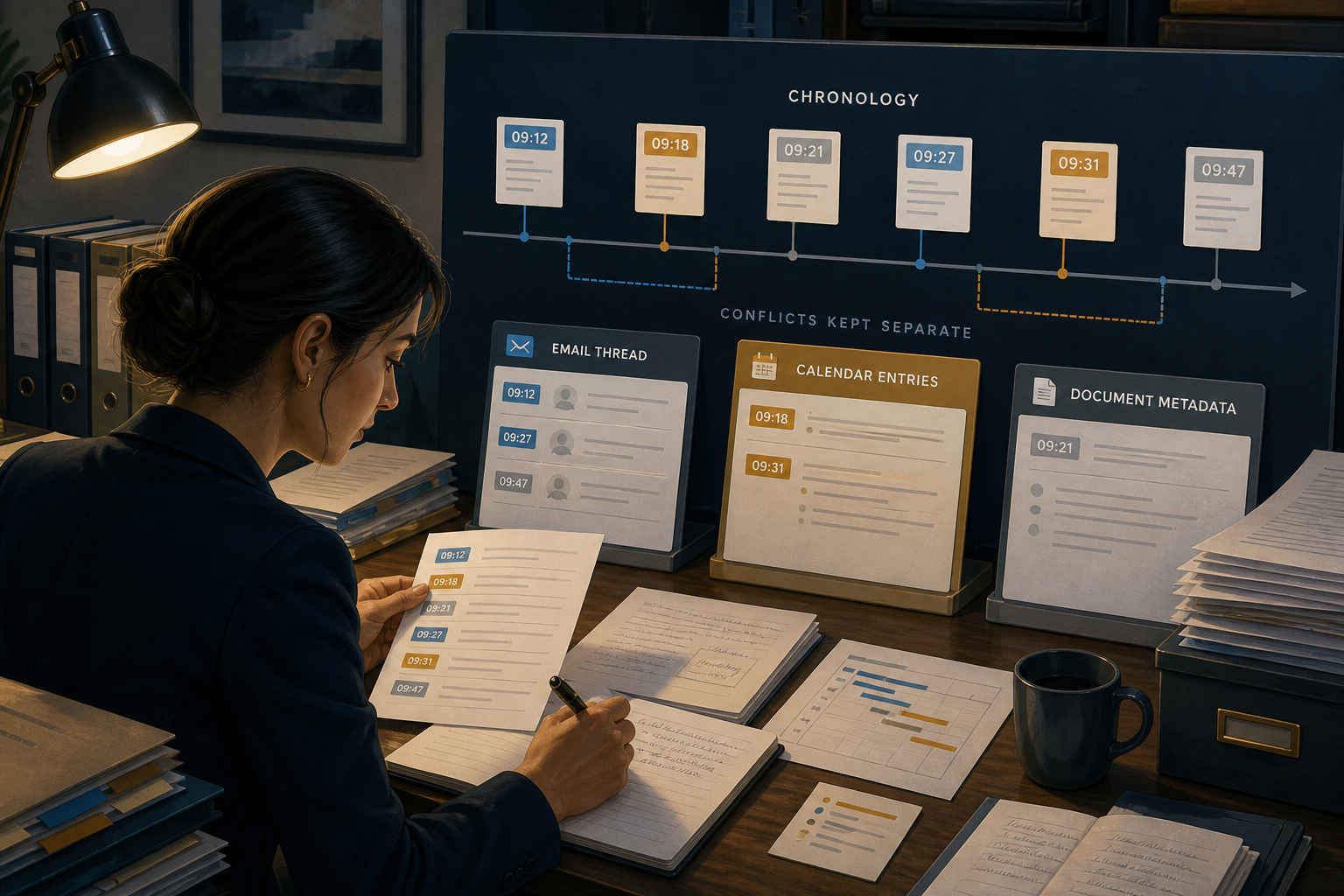
What evidence should offshore legal support preserve before a client update?
Research question: What can offshore legal support verify and organize before an authorized representative sends a client update? The question concerns draft preparation from supplied matter records: a task status, document receipt, appointment note, or reviewer instruction may be assembled into a proposed update. The worker can identify each source and wording, but should not predict an outcome, promise a deadline, give legal advice, or send a client-facing message without authorization. The study asks how a record can prevent an administrative summary from acquiring more certainty than its sources support.
Research into source control for draft status updates, separating verified matter events from predictions, promises, and attorney-owned communication.
 Workflow Design
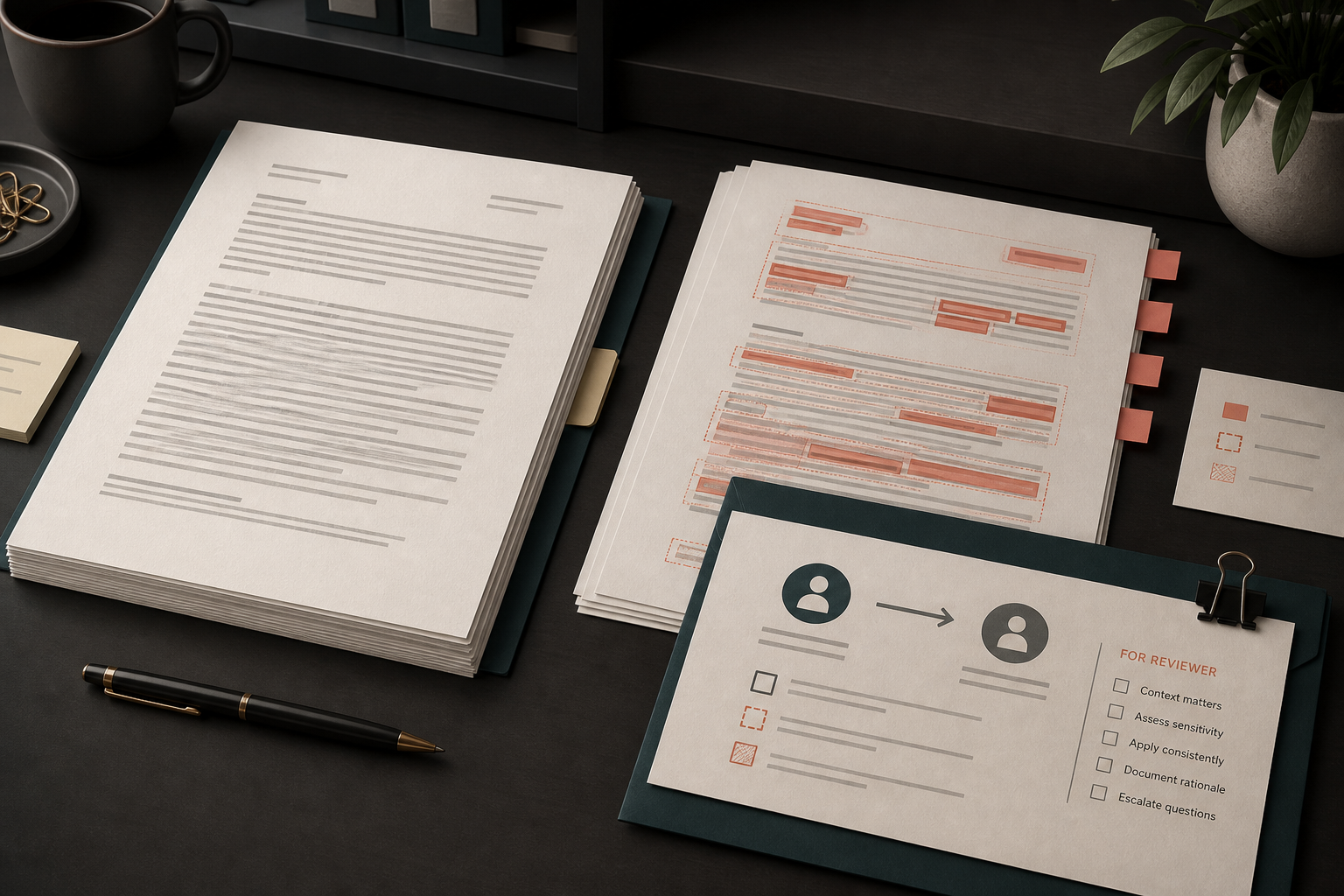
Can offshore legal intake preserve provenance before attorney review?
Research question: does every normalized intake value still point back to what was supplied?
A source-bounded study of how supervised legal support can organize incoming matter facts without turning normalization into legal judgment.
 Hiring Controls
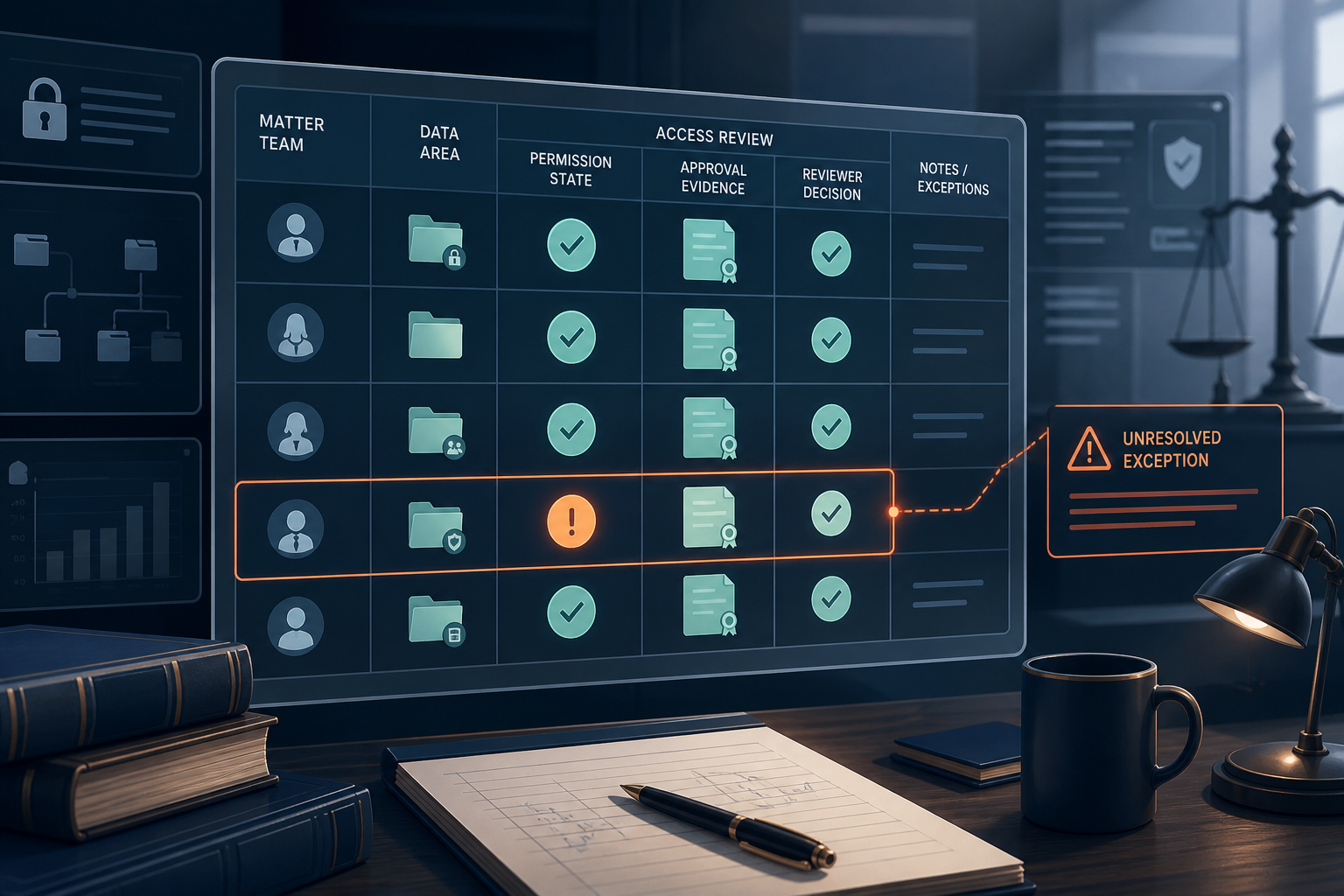
Can offshore legal support document portal entitlement without deciding access?
Observed capability, requested purpose, and authorization are different evidence fields.
Research on separating observed permissions, supplied business purpose, and approval evidence in supervised legal operations.
 Workflow Design
How should offshore legal support flag an expired knowledge source?
A broken citation is a review signal, not proof that the underlying instruction is wrong.
A study of source, version, owner, and review evidence for legal operations knowledge bases without silently rewriting instructions.
 Scope Benchmarks
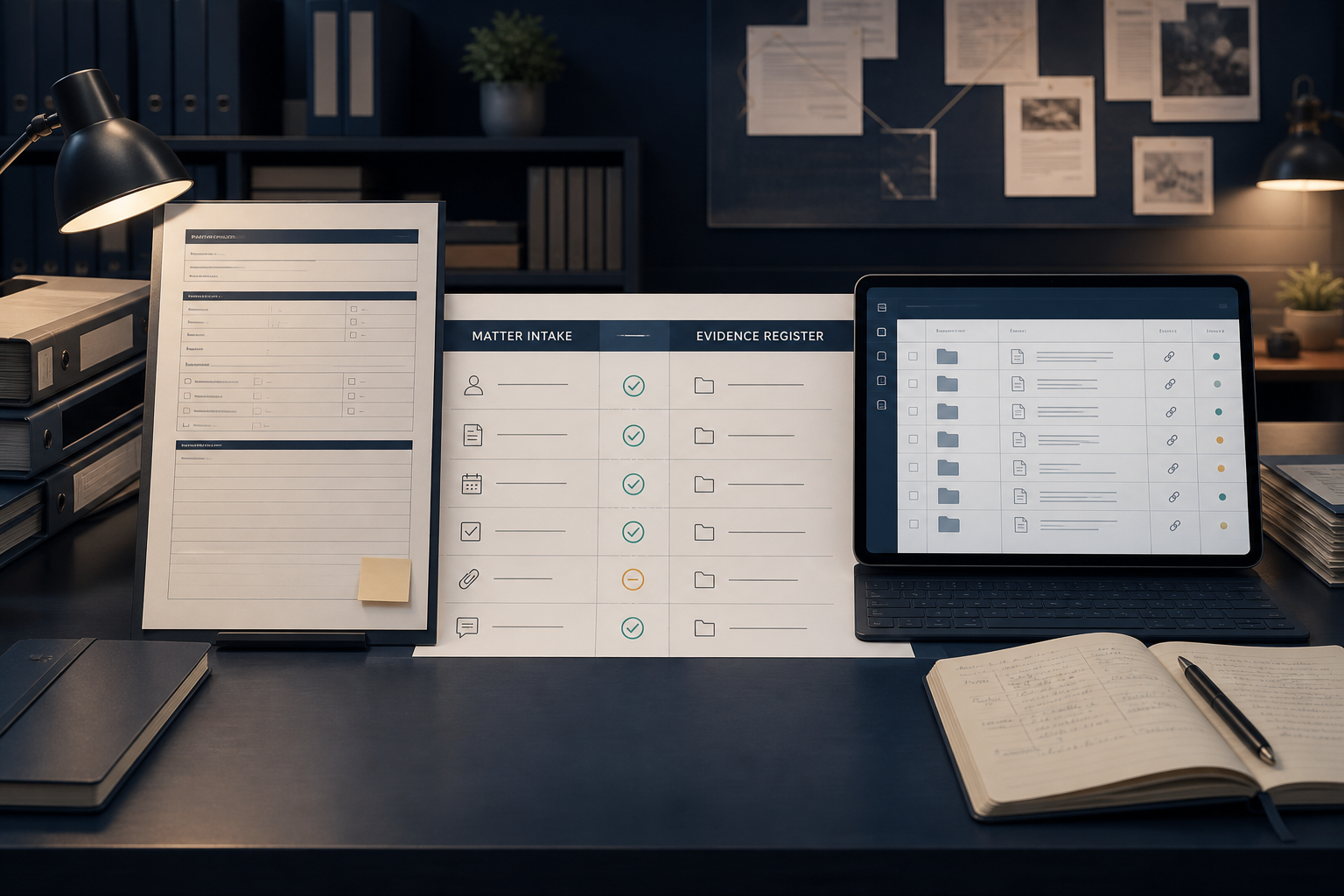
What can offshore legal support identify before a redaction decision?
A candidate location is evidence for review, not a completed withholding decision.
A research boundary test for surfacing candidate locations while preserving originals and leaving privilege and production decisions to authorized reviewers.
 Scope Benchmarks
When legal records disagree, can offshore support build a neutral chronology?
A chronology can show sequence without declaring which event controls a legal deadline.
Research on preserving timestamps, source labels, and time-zone uncertainty before an authorized owner decides what a date means.
 Workflow Design
Law-firm offshore document version lineage: can support prove which draft was reviewed?
A version-lineage study that separates file identity from legal approval.
Research on document lineage, version comparison, and review boundaries in offshore legal support.
 Hiring Controls
Legal support access recertification: does a permission record prove entitlement?
A six-source study of access observations, approval evidence, and escalation.
Research separating observed system capability from authorization in supervised offshore legal support.
 Workflow Design
Offshore legal intake source provenance: which facts are ready for review?
A six-source study of intake facts, uncertainty, and reviewer ownership.
A research study of source-linked intake preparation for supervised legal support teams.
 Scope Benchmarks
Offshore legal research support and authority currency: how should stale sources be surfaced?
A source-currency study that keeps retrieval separate from legal interpretation.
A research study of source currency checks for supervised legal research administration.
 Scope Benchmarks
Offshore legal support and deadline time zones: what can a date reconciliation record prove?
A time-context study for supervised calendar and notice administration.
A bounded study of time-zone evidence, source conflicts, and the line before deadline judgment.
Evidence QualityCan legal document production support preserve a source map without deciding responsiveness?
A provenance study for supervised document preparation in offshore legal operations.
Evidence-led research on document production preparation, source identity, and the boundary between locating records and deciding what they mean.
Access ControlsDoes access recertification evidence show entitlement, or only what a legal-support account can do?
A bounded study of access observations, approval evidence, and escalation.
Research on recertification records for offshore legal support, separating observed capability from firm authorization.
Scope BenchmarksHow can offshore legal support prepare a client update without inventing progress?
A source-integrity study for supervised status preparation and firm-side review.
A research study of source-linked client-update preparation, uncertainty, and the line between reporting activity and giving advice.
Workflow DesignWhat evidence should offshore legal support preserve before entering a calendar event?
A source-linked study of event entry as evidence preservation, not deadline determination.
A research question about calendar administration, source provenance, time zones, and the boundary around deadline judgment.
Intake EvidenceWhen can offshore legal intake normalize a fact pattern without changing its meaning?
A source-backed boundary study of intake fields, original wording, and reviewer decisions.
A research study of structured intake preparation, provenance, and the point at which normalization becomes legal interpretation.
Scope BenchmarksClient-portal permissions for legal support: a research boundary test
A bounded evidence study with source provenance, limitations, and owner review.
Original August 18, 2026 research on client portal permission review for supervised legal support.
Workflow DesignDuplicate-party review in legal intake: evidence before identity conclusions
A bounded evidence study with source provenance, limitations, and owner review.
Original August 18, 2026 research on duplicate-party review for supervised legal support.
Workflow DesignLaw-firm document metadata quality: evidence for safer support cleanup
A bounded evidence study with source provenance, limitations, and owner review.
Original August 18, 2026 research on document metadata correction for supervised legal support.
Scope BenchmarksLegal deadline source reconciliation: research on dates before judgment
A bounded evidence study with source provenance, limitations, and owner review.
Original August 18, 2026 research on deadline source reconciliation for supervised legal support.
Scope BenchmarksLegal knowledge-base source expiry: research on reviewable support content
A bounded evidence study with source provenance, limitations, and owner review.
Original August 18, 2026 research on knowledge-base source expiry for supervised legal support.
Scope BenchmarksLegal support email triage: research on routing without legal judgment
A bounded evidence study with source provenance, limitations, and owner review.
Original August 18, 2026 research on email triage routing for supervised legal support.
Scope BenchmarksLegal translation handoffs: research on preserving meaning for review
A bounded evidence study with source provenance, limitations, and owner review.
Original August 18, 2026 research on translation source preservation for supervised legal support.
Workflow DesignMatter status reporting for legal support: evidence without outcome claims
A bounded evidence study with source provenance, limitations, and owner review.
Original August 18, 2026 research on matter status evidence for supervised legal support.
Workflow DesignReconstructing a legal-support incident timeline: what evidence can show
A bounded evidence study with source provenance, limitations, and owner review.
Original August 18, 2026 research on incident timeline reconstruction for supervised legal support.
Workflow DesignRedaction candidates in legal support: preserving attorney review
A bounded evidence study with source provenance, limitations, and owner review.
Original August 18, 2026 research on redaction candidate preparation for supervised legal support.
Hiring ControlsClient-portal permission changes: a bounded legal support study
12 sources connect identity, purpose, least privilege, and change evidence.
Compare security and professional guidance on recording portal permission changes without granting support staff authority over client access decisions.
Scope BenchmarksContract renewal records: evidence before legal interpretation
12 sources support clause provenance, version control, and owner review.
Research how legal support staff can preserve renewal dates, notice sources, and owner assignments while counsel controls interpretation of contract terms.
Workflow DesignDocument-request priority in legal support: evidence without urgency judgment
12 sources distinguish request chronology from legal priority and response judgment.
Examine how a Philippines-based support role can organize document requests and aging evidence without deciding which omission creates legal urgency.
Scope BenchmarksForeign-language legal records: routing evidence before translation judgment
12 sources distinguish source preservation, language identification, and legal interpretation.
Compare confidentiality and source-preservation guidance for routing foreign-language legal records to the right reviewer without deciding meaning.
Workflow DesignHearing exhibit indexes: preserving integrity in legal support
12 authoritative sources support immutable source identity, version history, and review ownership.
Assess how a Philippines-based support role can maintain exhibit identifiers and source history while counsel controls selection, admissibility, and hearing strategy.
Scope BenchmarksLaw-firm case status reconciliation: source before summary
12 sources support source dating, discrepancy visibility, and accountable review.
Study how legal support staff can reconcile case-status fields across approved systems while leaving status significance and client communication with the firm.
Hiring ControlsLegal intake call records: provenance before handoff
12 authoritative sources frame source identity, purpose limits, and owner review.
Research how a Philippines-based legal support role can preserve intake-call facts and source context without turning notes into legal conclusions.
Hiring ControlsLegal support incident chronologies: reconstructing facts without assigning blame
12 sources treat event chronology as evidence, not a conclusion about intent or liability.
Research how support records can help a firm reconstruct a confidentiality or access incident while an incident owner controls scope, notification, and remediation.
Hiring ControlsMatter closure and access removal: what legal support can prove
12 sources connect closure evidence with authorization, retention, and access review.
Study the evidence needed to coordinate approved matter-closure administration and access removal without declaring a matter legally complete.
Scope BenchmarksRegulatory filing calendars: source review before legal deadline judgment
12 sources support source-linked dates, jurisdiction labels, and explicit uncertainty.
Examine how legal support staff can maintain filing-calendar source records while counsel decides which date, rule, or filing obligation controls.
Hiring ControlsClient document reminders: evidence and escalation for legal support
12 sources support approved language, recipient checks, and owner disposition.
Study the control boundary for sending approved document reminders without making promises or deciding legal sufficiency.
Scope BenchmarksCourt-notice date capture for legal support: source confidence research
12 sources support date provenance, time-zone visibility, and escalation.
Examine how support staff can capture dates from court notices while reserving deadline interpretation for counsel.
Workflow DesignEntity relationship evidence for legal support records
12 sources support exact source capture and reviewable relationship questions.
Research how support staff can organize entity names and relationships without making ownership, control, or conflict determinations.
Workflow DesignExhibit provenance in offshore legal support: preserving the review chain
12 authoritative sources connect source preservation with review ownership.
Assess how support staff can index exhibit materials while counsel controls relevance, sequence, redaction, and filing.
Scope BenchmarksLaw-firm billing source reconciliation: a research boundary
12 sources support source matching, correction history, and manager approval.
Compare evidence and confidentiality guidance on reconciling billing records without deciding what is billable or client-facing.
Workflow DesignLaw-firm matter opening source trails: evidence before entry
12 sources support source-linked administrative entry and visible exceptions.
Research how support staff can prepare matter-opening records while the firm controls acceptance, conflicts, and legal significance.
Hiring ControlsLegal support intake consent records: a bounded research review
12 authoritative sources frame purpose, provenance, and owner review.
Study how firms can record intake permission, source, and routing evidence without turning support staff into legal advisers.
Scope BenchmarksOutsourced legal-support change review: testing scope before expansion
12 sources support a documented change owner, permission review, and representative sample.
Compare professional and security guidance on expanding a support lane without silently expanding access or responsibility.
Hiring ControlsPrivilege source preservation for offshore legal support
12 sources reinforce original preservation, metadata integrity, and counsel review.
Examine how support staff can preserve review inputs and route ambiguity without deciding privilege or production status.
Workflow DesignRecord-retention hold evidence for legal support: what to preserve
12 authoritative sources support inventory provenance and authorized disposition.
Study how support staff can inventory retention and hold records while the firm controls policy interpretation and destruction decisions.
Workflow DesignClient instruction versioning for legal support: preserving the controlling request
12 sources support version provenance and visible approval ownership.
Compare evidence and confidentiality guidance on keeping approved client instructions linked to the work performed.
Hiring ControlsCross-border legal data transfers: what the record should show
12 sources distinguish transfer evidence from a legal transfer decision.
Study how firms can document purpose, recipient, channel, and owner review when legal information crosses a border.
Workflow DesignDuplicate legal matter records: evidence for safe administrative review
12 sources support evidence-based duplicate review rather than silent merging.
Assess how support teams can surface possible duplicate matter records while leaving consolidation and conflict decisions to the firm.
Hiring ControlsLaw-firm access-log review: what support evidence can establish
12 sources connect attributable events with bounded incident reconstruction.
Examine how access records help a firm investigate unusual legal-system activity without overstating what logs prove.
Scope BenchmarksLegal calendar source confidence: separating date entry from deadline judgment
12 sources support explicit source dates, owners, and uncertainty flags.
Research how a legal support role can record dates and source confidence without deciding which deadline controls.
Workflow DesignLegal support knowledge transfer: continuity without uncontrolled copies
12 sources support minimum-necessary knowledge records and source ownership.
Research how firms can transfer task knowledge while protecting matter information and preserving owner review.
Hiring ControlsLegal support role-permission mapping: a research test for least privilege
12 authoritative sources connect task scope with access scope.
Compare security and professional guidance on mapping legal-support duties to named permissions, review owners, and evidence.
Scope BenchmarksOutsourced legal-support scope changes: evidence before expansion
12 sources support a documented change owner, review sample, and access reassessment.
Compare outsourcing, security, and confidentiality guidance on changing a support role without silently expanding responsibility.
Scope BenchmarksPrivilege escalation signals in legal support records
12 sources distinguish preservation and routing from privilege judgment.
Identify factual signals that should pause administrative work and route a question to an authorized reviewer.
Hiring ControlsRedaction support and legal review: where the administrative boundary sits
12 sources reinforce source preservation, reviewer ownership, and escalation.
Analyze the evidence needed to prepare redaction work for attorney review without treating a field check as a privilege decision.
Hiring ControlsClient portal invitations: identity and access control research
12 sources map recipient verification to access accountability.
Examine the control points around inviting users, confirming recipients, and recording access changes in legal client portals.
Hiring ControlsCross-border legal support data safeguards: what firms must document
12 authoritative sources frame a documented cross-border safeguard review.
A source-backed analysis of the safeguards firms should document before allowing offshore support to handle client information.
Workflow DesignLegal document transfers: recipient verification before release
12 sources support recipient checks without turning transfer staff into legal advisers.
Study the evidence needed to verify recipients and approved channels before support staff move legal documents between systems.
Scope BenchmarksLegal outsourcing vendor oversight: an evidence-based review model
12 sources separate vendor evidence from the firm owner’s decisions.
Compare professional and security guidance on the evidence a firm should retain when overseeing an outsourced legal-support provider.
Workflow DesignLegal records search evidence indexing: measuring retrieval confidence
12 sources frame retrieval confidence as traceable evidence, not a completeness promise.
Define a research-backed way to record search scope, source locations, and unresolved gaps for supervised records work.
Hiring ControlsLegal research authority currency: keeping support files reviewable
12 sources support a clear distinction between source currency and legal analysis.
A research-led method for recording authority versions and review dates while reserving interpretation for counsel.
Workflow DesignLegal support incident evidence readiness: from alert to review
12 sources frame incident evidence as a reconstruction problem.
Analyze which records help a firm reconstruct a suspected confidentiality or access incident without assigning legal conclusions to support staff.
Scope BenchmarksSegregation of duties in legal support: where review should sit
12 sources connect role separation with accountable review.
Analyze how firms can separate preparation, approval, access administration, and exception handling in offshore support work.
Scope BenchmarksSupervised offshore delegation and legal confidentiality
12 sources distinguish delegation controls from legal judgment.
Compare professional guidance on delegation, supervision, and confidentiality when administrative legal work crosses borders.
Hiring ControlsZero-trust access for legal support teams: a research comparison
12 sources connect zero-trust design to legal support access decisions.
Assess how zero-trust principles translate into named access, narrowly scoped systems, and reviewable support work.
Scope BenchmarksBilling and time-entry integrity: a reviewable control set
12 sources support audit history and owner approval controls.
A control set for administrative time-entry support, exception review, and client approval.
Workflow DesignCase-file metadata quality: measuring retrieval readiness
12 sources support a metadata completeness and provenance test.
How to assess whether case-file metadata is complete enough for reliable retrieval and attorney review.
Workflow DesignContract obligation tracking: a source-backed workflow
12 sources support a clause-to-record traceability model.
Turn executed agreements into reviewable obligation records without giving operational staff legal authority.
Workflow DesignContract redline QA: separating formatting from legal judgment
12 sources support source-version checks and approval gates.
A quality-assurance workflow for redline preparation that keeps administrative checks distinct from legal review.
Workflow DesignCorporate records indexing: a practical completeness test
12 sources support inventory coverage and version controls.
Build a corporate-records index that makes missing documents and ownership visible.
Hiring ControlsE-discovery review queues: designing for traceability
12 sources support provenance, sampling, and review gates.
A defensible queue design for document review support, sampling, escalation, and audit trails.
Scope BenchmarksImmigration case status controls: preventing stale handoffs
12 sources frame status ownership, source dates, and escalation.
A control model for status records, document requests, and escalation in immigration case administration.
Workflow DesignLaw-firm document intake indexing: a completeness test
12 sources support inventory coverage, provenance, and review gates.
How support teams can index incoming documents while preserving source files, matter context, and review ownership.
Hiring ControlsLaw-firm intake source verification: a narrow control set
12 sources support minimum-necessary collection and exception routing.
Verify required identifiers and source completeness while routing ambiguity and legal significance to the authorized reviewer.
Hiring ControlsLegal citation library maintenance: a traceability workflow
12 sources reinforce proposition-to-authority traceability and review dates.
Keep authorities, versions, source dates, and research questions connected for supervised legal research support.
Scope BenchmarksLegal client follow-up queues: controlled administration
12 sources support explicit ownership, communication approval, and exception routing.
A workflow for tracking approved requests and reminders without making promises, giving advice, or changing priorities silently.
Hiring ControlsLegal data retention exception queues: administration controls
12 sources support documented retention decisions and restricted access.
Organize retention exceptions, owner decisions, and evidence without deciding legal hold or disposition questions.
Scope BenchmarksLegal deadline escalation matrices: a control-first design
12 sources support explicit date ownership and exception routing.
A practical matrix for recording dates, confidence, owners, and escalation thresholds before a deadline reaches counsel.
Workflow DesignLegal document version control: a reviewable operating model
12 sources support version provenance and visible approval gates.
A practical model for labels, source preservation, comparison checks, and approval before a document moves forward.
Workflow DesignLegal entity records change logs: preserving accountability
12 sources support version controls, source traceability, and owner approval.
A controlled change-log workflow for entity records, supporting documents, approvals, and unresolved discrepancies.
Workflow DesignLegal form completion quality controls
12 sources support source preservation, checklist discipline, and approval ownership.
Separate field completion and evidence checks from legal interpretation with a visible reviewer gate.
Hiring ControlsLegal intake data handoffs: a control-first benchmark
12 sources frame the intake handoff control checklist.
A practical benchmark for designing intake handoffs that preserve context, ownership, and privacy review.
Scope BenchmarksLegal matter status reporting: evidence before narrative
12 sources support traceable status fields and owner approval.
Design status reports around approved fields, source dates, exceptions, and attorney review instead of unsupported summaries.
Hiring ControlsLegal operations access reviews: a small-firm cadence
12 sources support recurring access review and deprovisioning evidence.
A repeatable access-review cadence for offshore legal operations support and sensitive matter systems.
Hiring ControlsLegal research source traceability: question to citation
12 sources reinforce proposition-to-authority traceability.
A repeatable source-traceability method for legal research support teams working under attorney supervision.
Hiring ControlsLegal support access deprovisioning: a defensible workflow
12 sources support recurring access review and documented deprovisioning.
A practical sequence for closing accounts, confirming ownership, preserving evidence, and escalating missed removals.
Scope BenchmarksLegal support onboarding controls: the first-week evidence set
12 sources support scope, access, training, and review evidence.
A first-week evidence set for onboarding a Philippines-based legal support workflow with clear boundaries.
Scope BenchmarksLegal support QA sampling plans: evidence-led review
12 sources support documented sampling, incident logging, and review ownership.
Build a sampling plan that surfaces rework, missing fields, and escalation failures without turning a sample into an unsupported performance claim.
Scope BenchmarksLegal work-product handoff checklists: preserving review context
12 sources support traceable handoffs and visible review ownership.
A checklist for handing prepared work to counsel with source notes, open questions, version details, and an explicit approval state.
Workflow DesignMatter closeout and retention checks: a safe administrative sequence
12 sources support separated closeout checkpoints and disposition review.
A closeout sequence for ownership, open tasks, document status, and retention review.
Hiring ControlsPrivilege-review administration: safe support boundaries
12 sources reinforce separation of coding administration from legal judgment.
A source-backed administration model for coding queues, preserving provenance, and escalating privilege questions to counsel.
Hiring ControlsSecure file-transfer checklists for law-firm support
12 sources connect secure communications, least privilege, and audit evidence.
A repeatable checklist for approved transfer channels, recipient checks, logging, and exception handling.
Workflow DesignDeposition preparation administration controls
12 sources support preparation records and explicit counsel review.
Scope scheduling, exhibit indexing, checklist updates, and logistics while keeping strategy and legal judgment with counsel.
Hiring ControlsLaw-firm client-portal administration model
12 sources support named access and auditable portal administration.
Define safe support work for portal invitations, document routing, status fields, and access exceptions.
Scope BenchmarksLaw-firm offshore work-queue design research
12 sources support explicit queue ownership and exception handling.
Design queues with defined inputs, service levels, review samples, exception states, and a stop rule for uncertain work.
Workflow DesignLaw-firm template governance review
12 sources support version provenance and approval ownership.
Create a controlled process for template inventories, version labels, approvals, and retirement of outdated legal-support materials.
Hiring ControlsLegal appeal record assembly workflow
12 sources support traceable record assembly and review ownership.
Organize approved record materials, citations, and deadlines with provenance controls and a clear attorney review boundary.
Workflow DesignLegal audit-request preparation controls
12 authoritative sources support evidence provenance and review gates.
A source-backed workflow for collecting audit evidence, preserving provenance, and routing judgment calls to a firm owner.
Hiring ControlsLegal client onboarding document controls
12 sources support minimum-necessary collection and reviewable handoffs.
A practical document-control model for collecting approved onboarding materials and routing missing or sensitive items.
Hiring ControlsLegal client-communication draft controls
12 sources support draft provenance, approval, and communication boundaries.
Set a safe drafting workflow for approved status updates while reserving advice, commitments, and sensitive responses for counsel.
Scope BenchmarksLegal matter opening checklist research
12 sources support a staged matter-opening checklist.
Standardize matter-opening preparation around approved identifiers, conflict-check status, access requests, and owner sign-off.
Scope BenchmarksLegal policy-change tracking controls
12 sources support source ownership, review dates, and escalation.
Build a source-monitoring and change-log workflow that routes interpretation and implementation decisions to authorized reviewers.
Scope BenchmarksLegal subpoena intake and triage workflow
12 sources frame date capture, ownership, and escalation controls.
Organize incoming subpoenas, capture service details, and escalate deadline or jurisdiction questions without making legal determinations.
Scope BenchmarksCorporate records calendar workflow research
12 sources frame a records-owner and approval model.
How support staff can maintain entity records and meeting calendars while reserving governance decisions for the client and counsel.
Scope BenchmarksEmployment case administration controls
12 sources support a documented case-status and escalation boundary.
Scope document collection, status updates, and hearing-date administration while keeping advice and strategy with counsel.
Workflow DesignLegal billing and time-entry control research
12 sources support a reviewable time-entry workflow.
Separate time capture, narrative cleanup, and invoice preparation from billing judgment and client communication.
Hiring ControlsLegal intake conflict-check workflow research
12 sources support a narrow intake record and explicit review gate.
Design an intake handoff that captures approved identifiers and routes potential conflicts to the firm’s authorized reviewer.
Hiring ControlsLegal knowledge-base access model research
12 sources support role-based access and source traceability.
Create a controlled internal knowledge workflow with source ownership, review dates, and permissions that match the material.
Workflow DesignLegal mailroom routing control research
12 sources support controlled correspondence intake.
Set a documented process for incoming legal correspondence, matter matching, date capture, and escalation of uncertain items.
Scope BenchmarksLegal operations handoff metrics research
12 sources support evidence-led operational reporting.
Measure queue completeness, rework, exception quality, and review latency without turning support metrics into unsupported promises.
Scope BenchmarksLegal translation handoff control research
12 sources support source preservation and reviewer sign-off.
Set boundaries for requesting, tracking, and reviewing translated legal-support materials without changing legal meaning.
Hiring ControlsLegal vendor due-diligence checklist research
12 sources support repeatable vendor evidence collection.
A practical review queue for vendor records, security evidence, contract status, and owner decisions.
Hiring ControlsLitigation discovery request tracker research
12 sources support traceable request ownership and escalation.
Build a controlled tracker for requests, custodians, due dates, and production status without making relevance or privilege calls.
Workflow DesignPrivacy request administration workflow research
12 sources support a documented request queue and decision owner.
Organize intake, identity-check status, search tasks, and deadline tracking while routing legal response decisions to counsel.
Workflow DesignReal-estate closing file checklist research
12 sources support a document-completeness and exception log.
A source-backed checklist for organizing closing documents, tracking missing items, and routing exceptions to counsel.
Workflow DesignCase-file naming and records cleanup research
12 sources support controlled records handling and traceable changes.
Use naming rules, examples, sampling, and narrow access to improve records without broad file exposure.
Workflow DesignContract administration workflow research
12 sources support a metadata-first contract workflow.
Define safe offshore contract administration around intake, metadata, renewal reminders, and counsel review.
Hiring ControlsE-discovery support chain-of-custody controls
12 sources support preservation, provenance, and review gates.
Organize collection administration and evidence logs while reserving legal scope and privilege decisions for counsel.
Scope BenchmarksImmigration case administration controls
12 sources frame a documented intake and escalation boundary.
Scope document checklists, status tracking, and client follow-up while routing legal advice and eligibility questions to counsel.
Scope BenchmarksLaw-firm offshore support quality scorecard
12 sources inform the evidence, logging, and review fields.
Choose a compact scorecard for accuracy, missing details, turnaround, rework, and escalation quality.
Scope BenchmarksLegal calendar and deadline control research
12 sources support explicit date ownership and exception routing.
Design a support workflow that enters approved dates, flags gaps, and escalates uncertainty before it becomes a missed deadline.
Hiring ControlsLegal case-file management access model
12 sources map access, logging, and incident-response controls.
A practical access and evidence model for remote case-file organization and status maintenance.
Hiring ControlsLegal client-data access review checklist
12 sources turn access review into a repeatable control.
A research-backed checklist for granting, reviewing, and removing access for offshore support roles.
Workflow DesignLegal document retention workflow research
12 sources support documented retention decisions and exception handling.
A practical boundary for retention labels, disposition queues, and attorney-approved exceptions.
Hiring ControlsLegal intake support control benchmark
12 primary sources frame the intake control checklist.
A source-backed control model for routing new legal inquiries without turning intake staff into legal advisers.
Workflow DesignOffshore legal document preparation: review-gate research
12 sources support a preparation-versus-judgment boundary.
How firms can separate formatting and checklist work from legal substance with visible approval points.
Hiring ControlsRemote legal support incident-response workflow
12 sources connect prevention, logging, and incident response.
Build a stop, preserve, notify, and review sequence for suspected access or confidentiality incidents.
Hiring ControlsWhere legal research administration should stop
12 sources reinforce traceability and a no-advice boundary.
Separate source gathering and citation organization from legal analysis, conclusions, and advice.
Methodology and use
Each research page should make assumptions visible, separate sourced facts from recommendations, and translate findings into a role brief your team can review.