
Legal Services Offshore research · Hiring Controls
Can offshore legal support document portal entitlement without deciding access?
Research on separating observed permissions, supplied business purpose, and approval evidence in supervised legal operations.
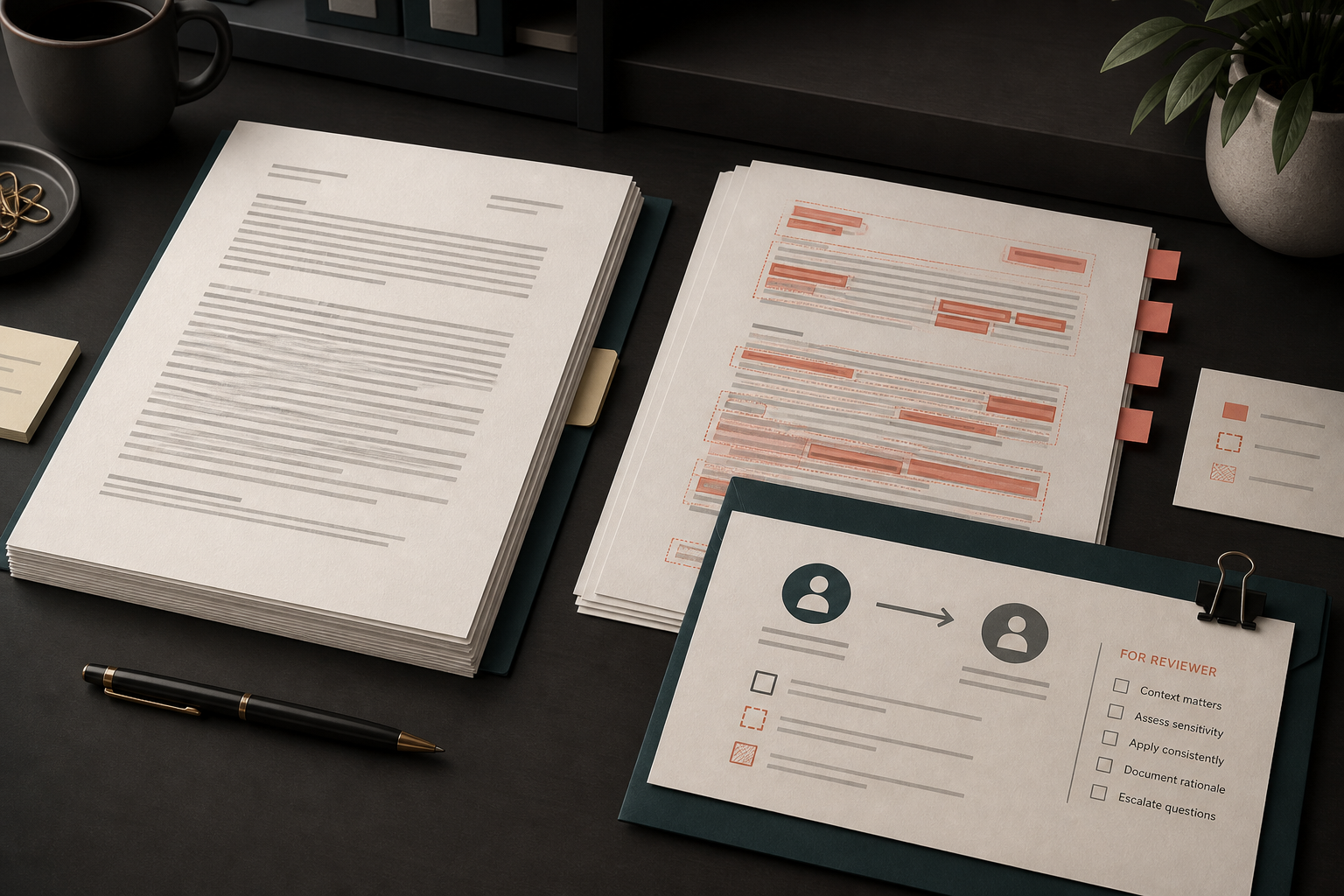
Evidence handling note
The access record should name both its observation boundary and its non-observation boundary. “Not observed” is different from “not present,” and preserving that distinction keeps the support note factual. It also tells the authorized owner whether a later technical review needs a new scope, account, or permission set.
Research question and evidence scope
Can a supervised offshore legal-support worker document what a portal account can do without deciding whether the person is entitled to that access? This question arises when a firm asks for an access review and the visible role name does not explain search scope, download capability, sharing options, or matter boundaries. The study examines a bounded evidence packet: requested purpose, account or group label, observed capability within approved scope, approval reference, review time, and unresolved exception. It does not authorize penetration testing, entitlement decisions, remediation, incident findings, or legal conclusions.
Methodology and evidence scope
The method compares ABA Formal Opinion 477R, NIST Cybersecurity Framework 2.0, NIST Zero Trust Architecture, ICO privacy-by-design guidance, and Law Society outsourcing guidance. Four hypothetical observations are tested: a read-only role that can search broadly, a guest account with an expired approval note, an upload permission that exposes recipient selection, and an inherited group whose owner is unclear. The analysis separates observed capability from business purpose and authorization. It is qualitative process research about a supervised handoff, not an access audit, penetration test, compliance certification, or claim about any firm’s security posture.
What support can document
Within a defined review scope, support can record the displayed role, permitted actions, visible matter range, approval reference, observation time, and system path used. It can note that a role appears able to search multiple matter areas without deciding whether that capability is appropriate. It can preserve an expired approval note and route the missing owner. It can describe a recipient selector without sending anything or treating the feature as proof that a disclosure occurred. The value is a legible distinction between what the system presented and what the firm intended. That distinction helps an authorized owner make a decision without asking the worker to guess.
Role boundary and control design
The worker should not probe beyond approved scope, add or remove users, change group membership, test exploitability, infer a disclosure, or approve an entitlement. Named accounts, least-privilege access, a recorded review window, and a firm-side escalation owner are essential. The task should also prohibit copying unnecessary matter content into the review note. An exception is not a finding of wrongdoing; it is a difference between observed capability, supplied purpose, and approval evidence. The owner decides whether to narrow access, obtain approval, request technical support, or accept the documented state. Support can update the record only under that instruction.
Limitations
A displayed role may not reveal inherited permissions, API access, cached data, or every path available to a user. An absent approval record does not prove that no approval exists, and an observed capability does not prove that it was used. The sources inform access governance and protected handling but do not decide a particular firm’s entitlement, notification, or remediation duty. A hypothetical sample cannot establish a portal’s security or a worker’s coverage. The firm must define the system boundary, evidence retention, review frequency, and responsible owner. Technical questions outside the approved observation require a separate authorized assessment.
Evidence-led conclusion
The evidence supports portal review when observed capability, requested purpose, and approval evidence remain separate. A supervised offshore worker can preserve those facts, identify a gap, and route it without deciding entitlement or remediation. For LegalServicesOffshore.com, the defensible output is a time-bound, source-linked exception record that keeps client information protected and makes the owner’s decision visible. Treating a role label as authorization is weaker than documenting what was actually observed and what remains unresolved.
Applied analysis for a supervised handoff
Suppose a firm asks for a review of a portal account described as read-only. The worker sees that the account can search across several matter areas and can open a recipient selector, but has no instruction to send, download, or change anything. A useful record names the displayed role, the permitted observation, the review time, the matter range visible within scope, and the approval reference supplied by the firm. It then states the discrepancy neutrally: the observed capability is broader than the role description appears to suggest, and the owner’s entitlement decision is pending. That record is different from saying the account is improper or that information was disclosed. Sampling can test whether every exception includes a source, observation window, and named owner; whether workers stayed within the permitted view; and whether notes avoided copying unnecessary client content. These checks make the role governable. They also create a practical distinction between entitlement evidence and security investigation. If the firm wants inherited-group analysis, API review, or exploit testing, that is a separate authorized technical task with different permissions and expertise. The support worker should not extend the review merely because the interface makes another path visible. A time-bound observation can become stale, so the record should not be read as a permanent statement about access. The firm owner may narrow a group, seek a new approval, accept a documented exception, or assign technical help. Offshore legal support contributes by preserving the comparison and routing the decision. Its value is lost if a generic access label is treated as conclusive or if a support note quietly becomes a remediation command. The review should also record what the worker was not permitted to inspect. A narrow negative statement about scope is safer than implying that unobserved permissions were absent. The record should separate “not observed” from “not present,” because that language protects both the reviewer and the support role from overclaiming. It also makes a later, separately authorized review easier to scope.