
Legal Services Offshore blog
Litigation deadline source chronologies with offshore legal support
A practical guide to deadline source chronology with source controls, reviewer gates, and clear offshore support boundaries.
A detailed operating walkthrough
For deadline source chronology, begin with court notice, filed order, docket export, service record, and counsel-approved calendar rule. The request owner identifies the permitted population before anyone opens a file. The coordinator then creates a record containing event label, source file, displayed date, received time, service evidence, calendar entry, conflict, reviewer, disposition. Each value stays beside its source location, because a correct-looking field without provenance cannot be checked reliably. The expected deliverable is a chronology that preserves every displayed date and unresolved conflict. That deliverable is administrative evidence, not a conclusion about legal effect. litigation counsel retains authority for every exception and for any action outside preparation. A realistic training case is this: An emailed notice displays October 8 while the attached order displays October 9. The coordinator records both sources and holds the calendar change for counsel. The correct response preserves both records, describes the difference neutrally, and stops the affected step. The team should rehearse that stop before volume begins. Reviewers should inspect ordinary items as well as exceptions, since quiet transcription errors can matter as much as obvious conflicts. The pilot is a fixed sample of 12 records from one approved deadline source chronology queue. Keep its population fixed, record exclusions, and compare results only against that defined sample. Measure source completeness, correct deadline source chronology fields, exception age, reviewer corrections, unauthorized actions prevented, and closure evidence. Separate missing inputs, worker errors, system failures, and delayed reviewer decisions rather than combining them into one accuracy number. Access should be limited to the exact folders and fields needed for this queue. Named accounts, approved transfer channels, session controls, and prompt deprovisioning make responsibility visible. If a date conflicts, service evidence is absent, a rule must be interpreted, or a filing decision is requested, the worker sends one focused question with the record identifier and source links. The reviewer records a disposition as a new event. No one silently overwrites the initial observation. This approach gives litigation teams reconciling court notices, orders, and counsel instructions a reconstructable workflow that can be narrowed, corrected, or stopped without pretending that a checklist replaces counsel.
Questions to settle before launch
The firm should answer practical questions specifically for deadline source chronology. Which source is authoritative when court notice, filed order, docket export, service record, and counsel-approved calendar rule do not align? Which portions of event label, source file, displayed date, received time, service evidence, calendar entry, conflict, reviewer, disposition may be normalized, and which must remain exactly as displayed? Who covers for litigation counsel when that reviewer is unavailable? What holding state prevents the item from moving forward while a date conflicts, service evidence is absent, a rule must be interpreted, or a filing decision is requested? How will the team detect that an instruction, template, system permission, or client restriction has changed? The written answer should identify the channel, response target, backup owner, and evidence required to resume. Training should use An emailed notice displays October 8 while the attached order displays October 9. The coordinator records both sources and holds the calendar change for counsel. as one scenario, then add a missing source, a duplicate record, an unexpected identity, and an unavailable reviewer. A worker passes only when the source is preserved, the uncertainty is visible, and no unauthorized judgment is made. During a fixed sample of 12 records from one approved deadline source chronology queue, supervisors should examine the first outputs in full and retain correction reasons. Before adding volume, compare source completeness, correct deadline source chronology fields, exception age, reviewer corrections, unauthorized actions prevented, and closure evidence. A higher exception count may reflect better detection rather than poorer work, while a zero-exception queue may indicate that staff are suppressing uncertainty. The decision to expand should therefore consider source accuracy, stopping behavior, access discipline, reviewer capacity, and closure evidence together. The final closeout confirms the output is a chronology that preserves every displayed date and unresolved conflict, every exception has an attributable disposition, temporary access is removed when no longer needed, and any external communication or legally consequential step remains with the firm.
Topic-specific control test
Test deadline source chronology against court notice, filed order, docket export, service record, and counsel-approved calendar rule. Record event label, source file, displayed date, received time, service evidence, calendar entry, conflict, reviewer, disposition and keep each observed value beside its source. The intended result is a chronology that preserves every displayed date and unresolved conflict, not a legal conclusion. Use this challenge case: An emailed notice displays October 8 while the attached order displays October 9. The coordinator records both sources and holds the calendar change for counsel. The preparer identifies the conflicting facts, preserves both source states, names the held action, and routes one precise question to litigation counsel. Next, test an unavailable source, a duplicate record, a changed instruction, and the condition that a date conflicts, service evidence is absent, a rule must be interpreted, or a filing decision is requested. Each case needs a visible stop, named decision owner, and attributable disposition. Keep the pilot to a fixed sample of 12 records from one approved deadline source chronology queue. Changing the population during review would make the evidence hard to interpret. At closeout, compare source completeness, correct deadline source chronology fields, exception age, reviewer corrections, unauthorized actions prevented, and closure evidence. Separate missing inputs from transcription mistakes, access failures, system outages, and delayed reviewer answers. For litigation teams reconciling court notices, orders, and counsel instructions, those categories show whether the lane needs better collection, clearer instructions, tighter permissions, more review capacity, or narrower scope. Preserve the original observation when correcting an item; append the actor, time, reason, and supporting source. Recheck access and instructions after a client restriction, platform change, repeated exception, or owner change. This evidence makes deadline source chronology a supervised administrative lane rather than an uncontrolled transfer of professional responsibility.
Topic analysis: deadline source chronology
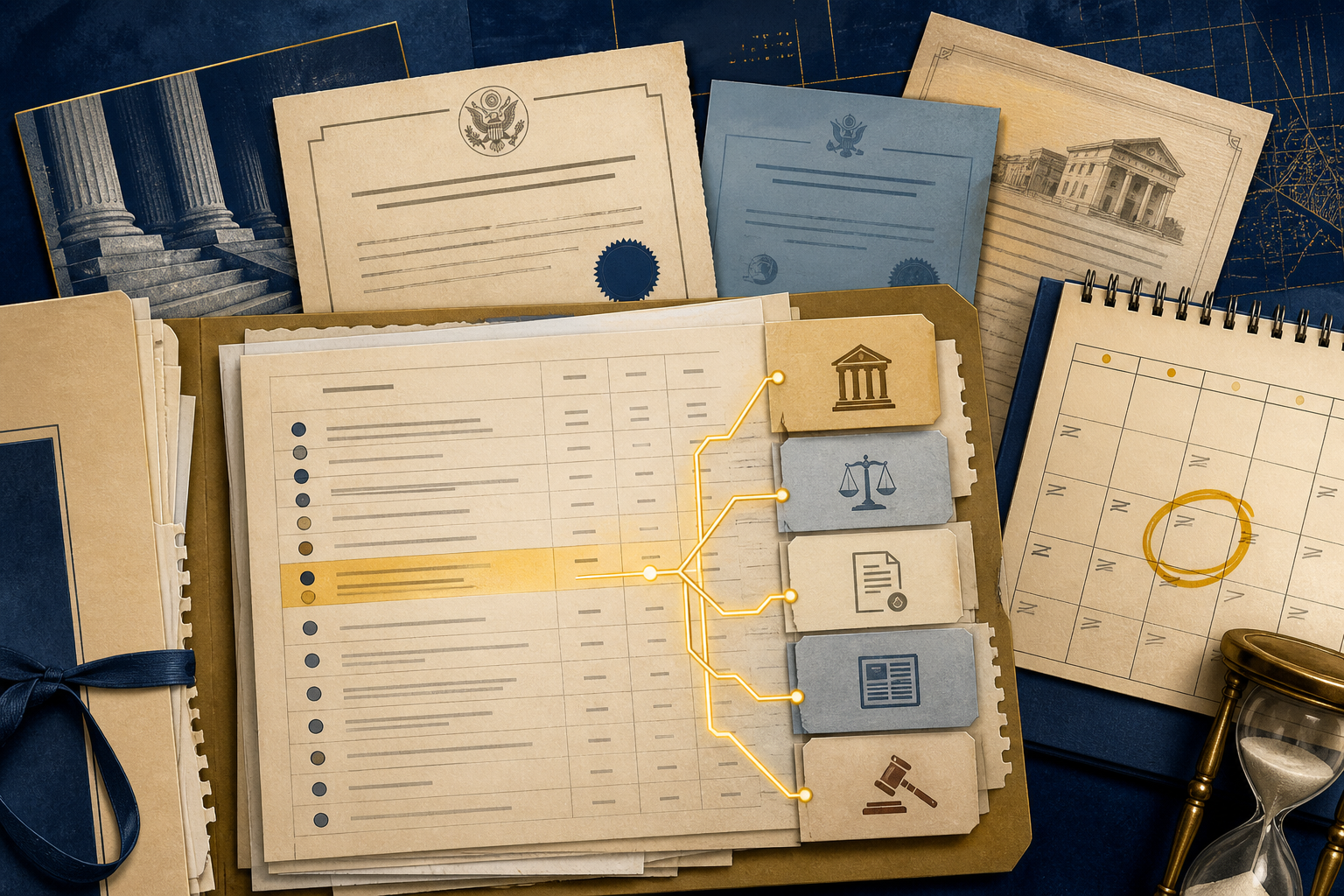
A deadline chronology distinguishes the date printed on an order from receipt, service, and the date counsel approved for calendaring. A useful packet places the docket entry, notice, service evidence, and current calendar record side by side. It records timezone and source version so a reviewer can explain a change without reconstructing the matter from email.
See how this workflow fits the Litigation operations service.
Sources
- American Bar Association, Formal Opinion 08-451
Consulted for supervision, competence, confidentiality, and client communication considerations when legal and nonlegal support is outsourced.
- American Bar Association, Model Rule 5.3
Consulted for lawyer responsibilities concerning nonlawyer assistance.
- NIST Cybersecurity Framework 2.0
Consulted for a current framework covering governance, access protection, detection, response, and recovery.