
Legal Services Offshore blog
Insurance-policy document inventories with offshore legal support
Inventory supplied policies, endorsements, and notices while lawyers control coverage analysis and legal conclusions.
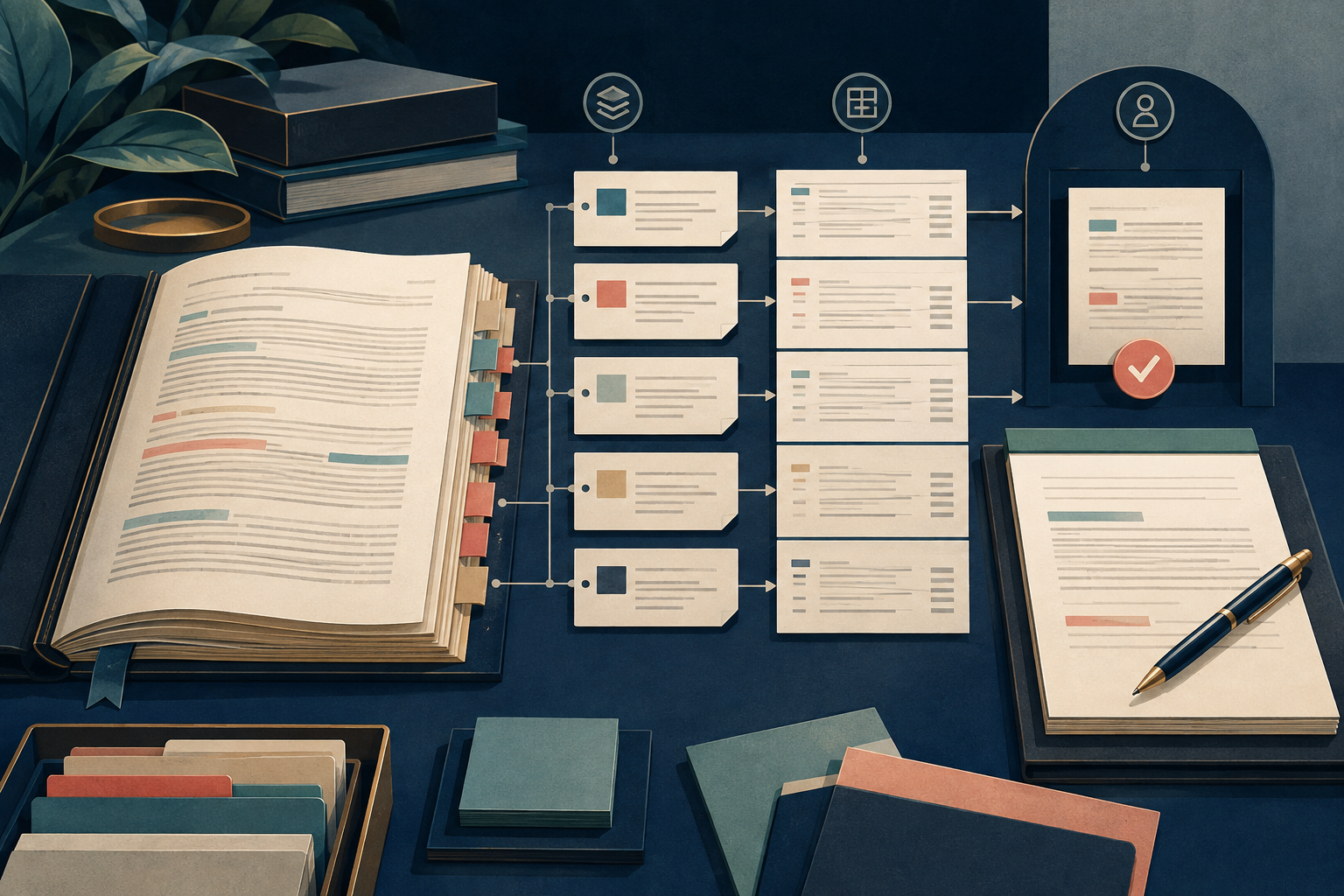
Define insurance-policy document inventory preparation in writing
Published September 4, 2026. Start with one named matter, a current instruction, and a narrow permission set. The brief should identify coverage counsel or the designated matter attorney as the reviewer and state that the support role may prepare factual records but may not make legal or client-facing decisions. Workflow 4 should have its own identifier so a later reviewer can reconstruct the handoff without relying on memory.
Keep the source set visible
Use only the supplied policy set, declarations, endorsements, notices, claim correspondence, and counsel taxonomy. Record the location and version of each input before extracting information. If two approved sources differ, preserve both and describe the difference plainly. Do not select the convenient version or search outside the authorized systems to fill a gap.
Prepare a reviewable record
The expected work product is an inventory preserving document identity, policy reference, visible period, endorsement link, source, and gap. Each entry needs an attributable source, preparer, observed state, open question, and next owner. A blank field should remain blank when the source does not answer it. Guessing makes a tidy record less trustworthy.
Stop at the decision boundary
Stop when forms conflict, a schedule is missing, dates require interpretation, or coverage must be characterized. Route the source and one precise question to coverage counsel or the designated matter attorney. Keep prepared, reviewed, approved, and released as separate states. Administrative completion does not establish legal sufficiency, compliance, privilege, or authority.
Test a small first batch
Use a closed or redacted example before live work, then review a small representative batch. Include ordinary items and at least one exception. Classify corrections by source, version, access, instruction, field, or decision boundary so the firm can repair the process instead of relying on a vague accuracy score.
Protect matter information
Use named accounts, matter-limited folders, approved devices, and approved transfer channels. Keep client facts out of general coordination notes. Unexpected access, a wrong recipient, or material in an unapproved location should pause the task and enter the firm's incident or access-review path.
Close with owner evidence
Close the item only after coverage counsel or the designated matter attorney records a disposition. Link corrections to the earlier observation instead of overwriting history. Remove temporary access when the assignment ends, retain only the evidence required by firm policy, and revisit the workflow when its system, source, client instruction, or risk changes.